

A Paris Ceramics Guide to Antique and Aged French Limestone Flooring
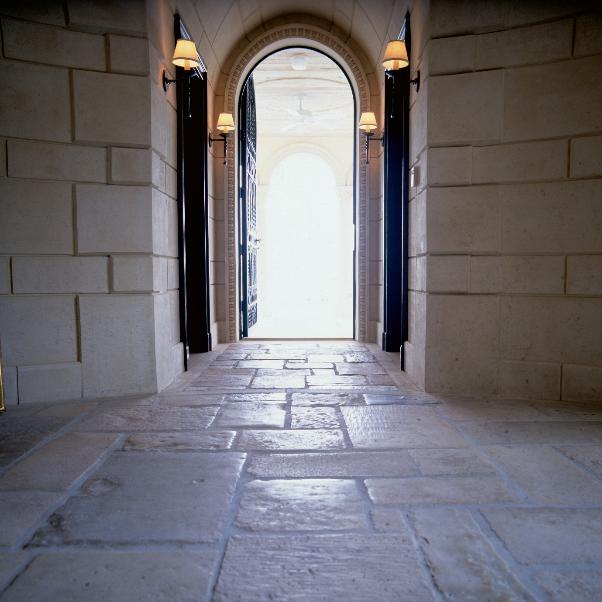
Overview
For Architects, Interior Designers and Project Teams
At Paris Ceramics, so much of what we do has you in mind. We know professional readers need more than attractive editorial. You need well-researched material insight that can support specification, spark design ideas, and add value to your CPD record. So we have done the research for you and turned our knowledge into something clear, useful and easy to apply.
To make that value immediate, we have also included two CPD-friendly templates at the end of the article: one for architects and one for interior designers. They are designed to help you log the learning quickly and with minimal effort.
We see architects, interior designers and project teams as important long-term partners and collaborators in the way we work, think and create.
Estimated Reading Time: 27-30 minutes
It was an ancient Celtic belief that stone could hold or reflect human energy, a notion that feels true both literally and metaphorically when one enters the fascinating world of antique, reclaimed French limestone flooring. The name itself conjures sun-washed images of Provençal villas and old country houses, with their spacious entrance halls, fragrant wine cellars, and busy kitchens. To us at Paris Ceramics, antique reclaimed French limestone floors such as Dalle de Bourgogne, Antique Reclaimed Grey Barr, and Blonde Barr speak of two histories that have always run in parallel: one geological, the other human and deeply personal.
Ewhurst Park – Detail of Dalle de Bourgogne Floor by Paris Ceramics
The fact that they not only carry colour and texture, but memory too, is part of why these floors look and feel so different from newly manufactured surfaces. An antique reclaimed floor has known centuries of footsteps, shifting light, daily use, careless spillages, and the gradual polishing effect of life itself. Its softened edges, mellowed tones, and undulations are not manufactured, but are rather a physical record of time.
This article looks at three of the principal antique French limestone floors in the Paris Ceramics world: Antique Reclaimed Dalle de Bourgogne, Antique Reclaimed Grey Barr, and Antique Reclaimed Blonde Barr. It considers their origins, their differences, their installation, and the reasons they continue to matter so much in contemporary interiors.
What Is Antique Reclaimed French Limestone Flooring?
The term “antique French limestone flooring” is exclusive to limestone tiles sourced and salvaged from abandoned, decaying, or demolished historical buildings across France.
Many of the antique French limestone floors that survive in circulation today were first laid in the 17th, 18th, and 19th centuries, in bastides, châteaux, churches, private manors, and other substantial regional buildings across Burgundy, Provence, and the Loire Valley.
The uses given to them across different generations, often spanning hundreds of years, mean that Dalle de Bourgogne, Antique Reclaimed Grey Barr, and Blonde Barr specifically bear the marks, grooves, and patina of their former residents, which gives them a unique, inimitable character: traces of lives past preserved in the permanence of stone.
In terms of design and architecture, it is easy to appreciate why not only many discerning homeowners, but interior designers and architects alike, are all passionate about antique French limestone flooring.
Owing to their combination of durability and elegance, they transcend the often-faddish ebb and flow of trends, ensuring that their current owners’ investment not only remains timelessly elegant, but also greatly adds to the future value of whatever property antique reclaimed stones may inhabit.
In our current world of excessive consumption and an unhealthy obsession with materials and products that are cleverly made to break, wear, or tear so that we are unwittingly nudged to replace them, antique limestone flooring has the advantage of both durability and sustainability.
What better testament, then, to the continuity of change than the fact that one may not only showcase the striations of time upon stone in one’s home, but also add one’s own marks to the continuing recycling and curation of human life and taste?
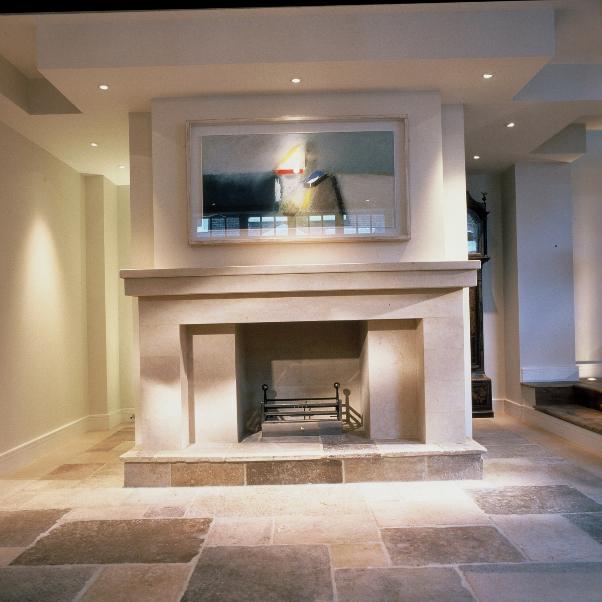
Antique Dalle de Bourgogne Floor
Antique Reclaimed Dalle de Bourgogne
Almost as famous for its wine as for its stone, Burgundy is the native region of antique Dalle de Bourgogne stone, one of the great reclaimed limestone floors of France. This is an especially hard Jurassic limestone, traditionally used in old houses, farm buildings, and more grandiose private estates.
Stonemasons originally split the stone rather than sawing it, producing regular shapes that were then finished by hand. That process helped give the material its character, but it also meant that the flagstones often arrived with significant variations in depth.
Dalle De Bourgogne: Sizes, Thickness and Specification
That depth is part of the Dalle de Bourgogne story, but for architects and designers it also needs to be understood in practical terms.
At Paris Ceramics our Antique Dalle de Bourgogne flagstones are available in both random and coursed formats.
Because the flagstones can arrive at significant thicknesses before preparation, we cut them down to circa 3cm for easier installation, shorter floor heights, and reduced transport weight.
In the process of cutting the stone down, the second cut (or second face) is then revealed. It is worth noting that this second face should not be considered wastage and can be creatively reused.
A useful way of thinking about it is this: although the second face is a part of the stone that has never seen the light of day, limestone is porous, and over time the effects of spillages, water, cleaning, and oxidation seep into it. That is why the second face, despite being a newly revealed part of the slab, can still carry interesting patterns and colouration that relate back to the patina of the first cut.
The second cut can then be antiqued and distressed to give it a new life of its own, and may also be combined with the first cut, as we will explore later in the section “When to Use Antique Reclaimed vs. Aged or Distressed Stone.”
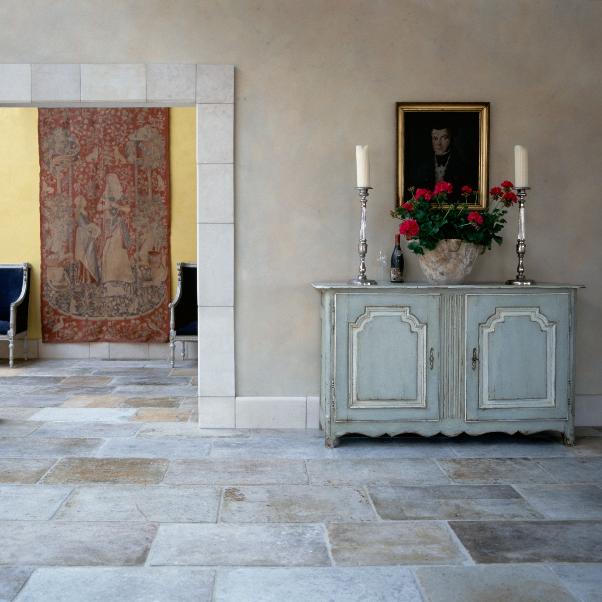
Antique Reclaimed Grey Barr
Antique Reclaimed Grey Barr
If Dalle de Bourgogne has a more elemental depth, Antique Reclaimed Grey Barr introduces a cooler, more formal register. Originating from the area surrounding the Montpellier region, it tends to appear in long rectangular formats whose proportions bring a stronger architectural feel to a room. Its greyer tones make it especially well-suited to grand entrance halls, kitchens, larger open spaces, and interiors where order and balance are as important as atmosphere.
Part of what gives Antique Reclaimed Grey Barr its authority are the kinds of buildings it often comes from. These stones are not only associated with the grander domestic architecture of the south of France, but sometimes with old boarding schools, places shaped by years of relentless footfall and the daily rhythm of communal life; its greys deepened by use, its edges softened by repetition, and its character formed as much by human movement as by the slow crawl of centuries.
Unlike Dalle de Bourgogne or Blonde Barr, Antique Reclaimed Grey Barr has a characteristic distinct from the other two, and this is where the specification becomes important.
Antique Reclaimed Grey Barr: Sizes, Thickness and Specification
At Paris Ceramics, Antique Reclaimed Grey Barr flagstones are supplied at circa 70 to 75 cm long by 50 to 55 cm wide, with a thickness of circa 3 cm.
In other words, they already arrive at the depth that contemporary projects usually require, which is why they are not cut down in the same way as Dalle de Bourgogne and do not produce a second face.
Their larger, more consistent rectangular sizing is part of what gives them such composure, lending them to interiors where scale, order, and architecture matter as much as patina.
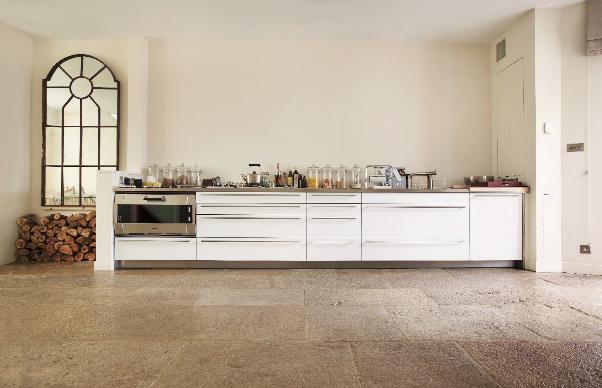
Antique Reclaimed Blonde Barr Floor
Antique Reclaimed Blonde Barr
If Antique Reclaimed Grey Barr speaks in a cooler, more formal register, Antique Reclaimed Blonde Barr belongs to a warmer and more domestic southern French tradition. Also associated with the Languedoc region and historically used in grand country houses, it carries a blonde-beige colouration that feels gentler and more sunlit than the greyer Antique Reclaimed Grey Barr. Yet its appeal is not merely tonal.
What gives Antique Reclaimed Blonde Barr its usefulness in architectural terms is the way that warmth is held within a more disciplined format. In that sense, Blonde Barr occupies a particularly interesting position within the antique French limestone family. It is less austere than Antique Reclaimed Grey Barr, yet more composed than its warmth might first suggest. For designers, that can make it a particularly versatile material: capable of bringing ease and softness to a room without sacrificing architectural order.
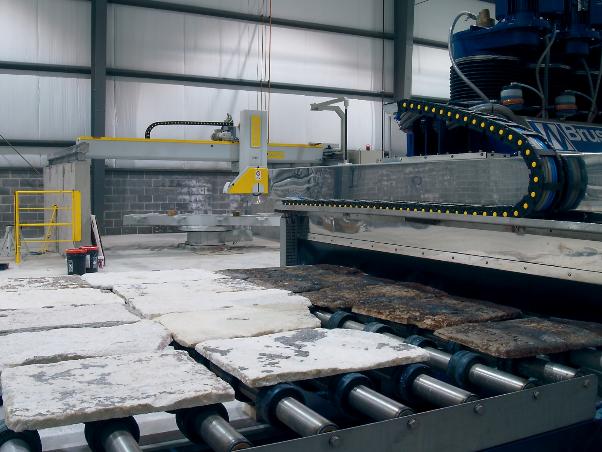
Antique Reclaimed Blonde Barr Being Cleaned at Paris Ceramics Facilities
Antique Reclaimed Blonde Barr: Sizes, Thickness and Specification
Antique Reclaimed Blonde Barr remains especially attractive because, like Dalle de Bourgogne, it can often yield a second cut, but it also has a more defined format than the warmth of its appearance might first suggest.
At Paris Ceramics, our Blonde Barr sits at circa 70 x 50 cm, and is cut down to a thickness of circa 3 cm. It is commonly installed in coursed lengths and is also available in hexagons and octagons
The second cut can be distressed and given new life as well. In that sense, Blonde Barr stands apart from Antique Reclaimed Grey Barr not only in tone, but in the variety of ways it can be reworked, reused, and specified.
Provenance, Scarcity and Selection
The provenance of reclaimed stone is not simply a question of source, but of condition, continuity, and architectural afterlife: where the material began, how it was used, and what still remains legible in it now.
Reclaimed floors are lifted from older buildings and brought back into circulation as finite batches, which means they do not behave like standardised new production. Tone, wear, thickness, edge condition, and even the degree of patina can vary not only from stone to stone, but from one batch to another.
Geographically, the supply chain for antique reclaimed stone flooring is typically pan-European and sometimes broader, as in the case of Antique Reclaimed Jerusalem Stone, Antique Reclaimed Hebron, and Antique Reclaimed Negev, all native to different regions of Israel. Many suppliers position themselves as sourcing across multiple countries and then consolidating/processing stock at workshops before export.
That broader geography and fragmented supply chain help explain why reclaimed flooring rarely behaves like a continuous, repeatable product line. In many cases, what comes to market may be a small singular lot with its own dimensions, tonal balance, and history, which is precisely why the possibility of antique one-off floors should be considered.
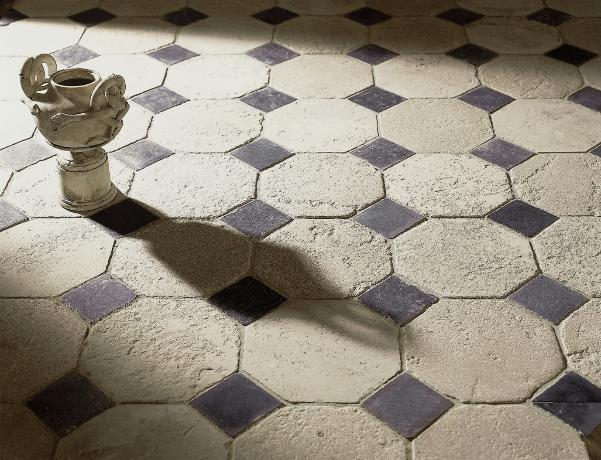
Detail - Antique One-Off Floor
Antique One-off Floors
In this world, a “one-off” floor refers to a limited batch of antique reclaimed stone from a particular source, with its own proportions, colour balance, and history.
At Paris Ceramics, we source such rare one-off floors, but by their nature they are available only in limited quantities, and never in the kind of continuity one would expect from newly quarried material.
Selection, Approval and Supplier Standards
Because antique reclaimed stone is so individual, batch photography, approval, and pre-selection are common and important parts of the process. This is also where long-standing supplier relationships begin to matter.
Because Paris Ceramics has long worked to exacting standards around size, patina, and colour, and has nurtured close relationships with our suppliers, they understand that, for our purposes, selection cannot be casual. Often, larger and better flagstones are set aside, smaller or less suitable ones are filtered out, and what we receive is a more carefully chosen floor.
In that sense, quality must always begin well before installation. It needs to begin at the point of selection, in knowing what to keep, what to reject, and how to recognise the best of what an antique lot has to offer.
Rather than relying on a small sample to stand in for an entire order, we are often shown the actual batch, either through photographs, laid-out selections, or direct viewing, so that tone, size variation, wear, and overall balance can be judged before the floor is committed to a project. In other words, the approval process is one of the ways antique reclaimed stone is specified intelligently, with full awareness that no two historic lots are ever exactly the same.
A practical implication for specifiers is that reclaimed floors often behave more like architectural salvage inventory than like standardised tile: availability is episodic, continuity across phases can be difficult, and samples can be less representative than in new production; hence the importance of lot-based selection and dry-lay or mock-up services where offered.
Heritage Law, Traceability and Export
In France, the reclamation and export of antique limestone sit within a broader heritage framework designed to protect historically significant material and to ensure that what is reused has been lawfully removed, documented, and handled with appropriate care. For us, that matters because provenance is not only a question of beauty or age, but of responsibility. At Paris Ceramics, we do our utmost to work in a way that respects the spirit of these protections, valuing traceability, careful sourcing, and the proper stewardship of materials that form part of a wider architectural inheritance.
How a Connoisseur Reads the Marks and Traces of Antique Stone
One of the fascinations of antique reclaimed stone is that it’s the story of its provenance and former use is not limited to documented traceability, regions, or dates; it sometimes survives in the surface itself.
Antique reclaimed stone can carry all kinds of residual traces from its earlier life: the marks of the craftsmen who first worked it, the signs of later adaptations, and the small physical clues of how it was once used within a building.
In some cases, these traces take the form of stonemasons’ marks, sometimes known as banker marks, carved into blocks or floor pieces as part of the working grammar of the craft. For thousands of years, such marks helped identify which mason had shaped a particular piece, allowing work to be counted, checked, and, where necessary, questioned.
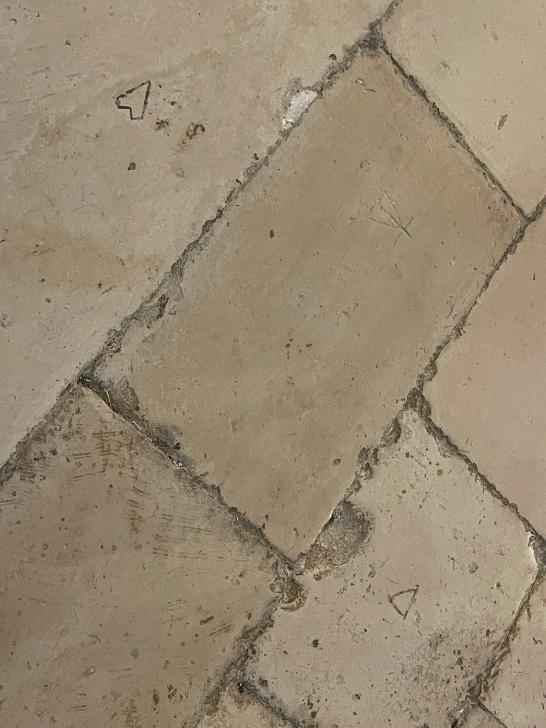
Banker Mark Inscriptions - Batalha Monastery, Portugal
In that sense, they served several purposes at once: a practical system of payment, a form of quality control, an assembly guide for more complex settings, and, just as importantly, the signature of a skilled craftsman. They are not always present, but when they do appear, they bring with them a particular intimacy, a reminder that the floor was once handled, judged, and shaped by identifiable human hands.
However, not all signs left in old stone are so deliberate. A reclaimed floor may also retain remnants of paint, small iron traces, filled holes, or marks left by old fittings and alterations. These can derive from former door hardware, hinges, boot scrapers, thresholds, or earlier architectural adjustments made over the life of a building.
Paint, too, may linger in unexpected ways. In earlier centuries, the use of red on floors and surrounding architectural elements was never purely decorative. It often carried associations of status, ceremony, and authority, while also allowing more ordinary surfaces to borrow something of the visual richness of costlier materials. In that sense, red could function both as display and as enhancement: a way of lending a building greater presence, while also protecting and refreshing surfaces through repeated treatment. Its social resonance mattered too. Strong red tones were long tied to ideas of rank, power, and prestige, which helps explain why they appeared so confidently in more elevated interiors.
Even when that surface treatment has been removed, a memory of it may still remain in the stone. These details are not defects in the modern sense, but should be valued and worked with as part of the record the material keeps.
That is part of what makes antique limestone so compelling. A reclaimed floor of this kind does not simply offer colour, patina, and age. It offers signs of work, use, adaptation, and survival. Its surface may carry not only the beauty of wear, but the afterimage of thresholds crossed, fittings changed, rooms repainted, and lives repeatedly lived around it.
When to Use Antique Reclaimed vs. Aged or Distressed Stone
The term antique reclaimed stone should be used precisely. In this article, it refers to limestone that has been salvaged from old buildings and brought into a new architectural life.
That matters because antique reclaimed stone is often confused with new stone made to look old. The two can sit close together visually, but they are not the same, and the distinction becomes especially important when specifying for budget, consistency, and architectural intent.
In practical terms, this section distinguishes between antique reclaimed first-cut stone, antique distressed second-cut stone, and newly quarried aged or distressed stone, each of which has its own role within a project.
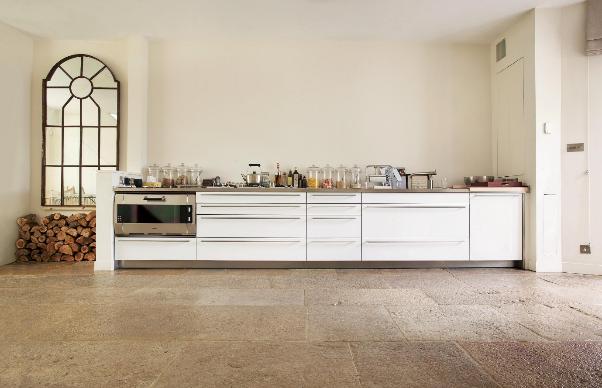
Antique Blonde Barr First-Cut Floor
Antique Reclaimed First-Cut Stone
The first cut, sometimes also referred to as the first face, is the original exposed surface carrying the centuries-old patina. Stones such as Dalle de Bourgogne and Blonde Barr often arrive at thicknesses far greater than most finished floor heights and must therefore be cut down. It is this uppermost antique surface, the part shaped by long use, cleaning, spillages, and wear, that forms the first cut.
When working with antique reclaimed first-cut stone, good specification must take into account quantity, budget, finished floor heights, technical constraints, and the level of consistency the project demands.
At Paris Ceramics, we advise that first-cut antique flagstones are generally the right choice for the principal interior areas of a scheme, where the full depth of original patina and historical character is most important.
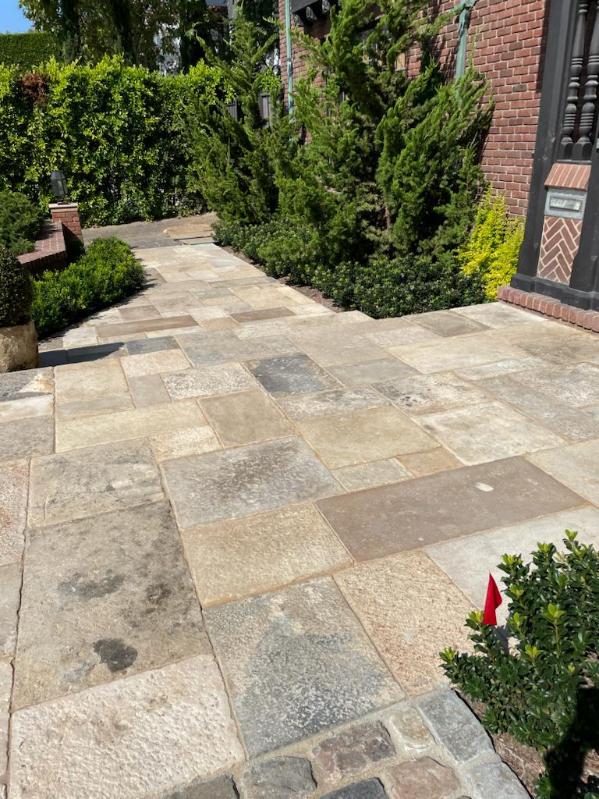
Antique Bourgogne – Mixed First and Second Cut Exterior
Antique Distressed Second-Cut Stone
Once the first cut has been taken, the newly revealed surface beneath it can be aged or distressed by skilled craftsmen so that it sits more comfortably alongside the original antique material. This is still antique stone, but it is not the original first face.
Antique distressed second-cut stone can be an intelligent solution where a client wants much of the atmosphere and continuity of an antique floor, but the exclusive use of first-cut material alone becomes less suitable because of budget or sourcing limitations.
In that sense, it is not simply a cheaper substitute, but a form of value engineering that can help a scheme remain coherent while using the most precious antique material where it matters most. This approach tends to work especially well in exterior settings, where weathering and use help the patina settle and blend more quickly, though it may also be used indoors in more secondary areas when handled with care.
When thoughtfully specified, a combination of antique first-cut and antique distressed second-cut stone need not feel compromised or visibly diluted. On the contrary, it can become part of the intelligence of the project, balancing authenticity, practicality, and cost in a way that remains materially convincing.
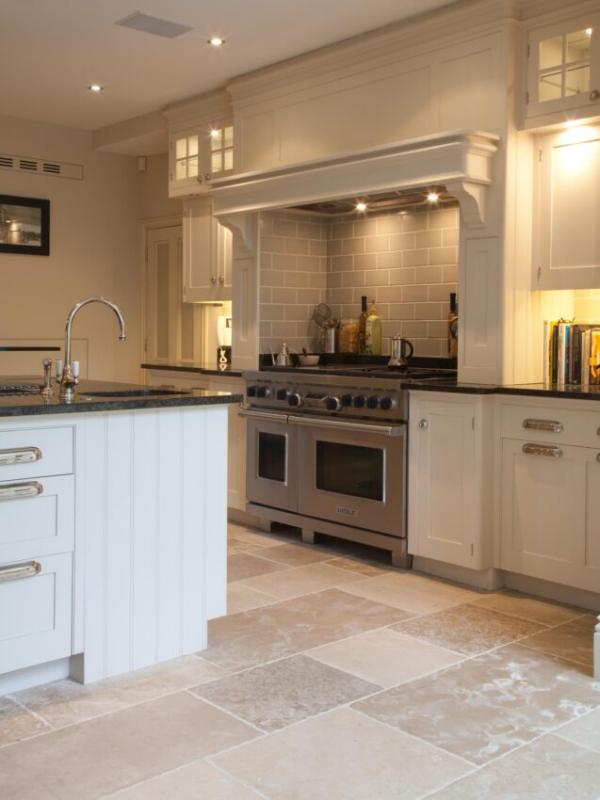
Antiqued or Aged Bourgogne Claire
Newly Quarried Antiqued or Aged Stone
A third category is newly quarried stone that has been aged or distressed to look and feel older.
This can produce a visually sympathetic effect, but it should not be confused either with antique reclaimed first-cut stone or with antique second-cut stone that has subsequently been distressed. It is a different material category altogether.
At Paris Ceramics, when newly quarried stone is distressed, the process is never handled generically. We think about how a floor would naturally wear according to its position in a room, allowing areas of greater imagined traffic to carry a little more depth and softening, while zones with less footfall remain less worked, because believable ageing depends not only on texture, but on rhythm, distribution, and an understanding of how time actually settles into a floor.
When handled well, newly quarried aged or distressed stone can retain much of the warmth, texture, and visual ease that people respond to in antique material, while offering greater flexibility in budget, sourcing, timing, and installation. Our wider Aged Stones and Aged Marbles, for example, reveal the elegant versatility of this approach, particularly where the spirit of an old floor is desired but the conditions of the project call for a more controlled or scalable solution.
Installation and Practical Considerations
Thickness, Floor Heights, and Build-Up
Because Dalle de Bourgogne and Blonde Barr vary considerably in thickness, this should be one of the first issues specifiers address with these two stones.
Antique material was never intended to conform to modern manufacturing tolerances, and if that issue is not resolved early it can create unnecessary complications on site.
The stones must be cut down for easier installation, to allow for shorter floor heights, and to reduce transport weight. Antique Reclaimed Grey Barr does not need cutting, because it already tends to arrive at the practical thickness required.
Underfloor Heating
Dalle de Bourgogne, Blonde Barr, and Grey Barr all work very well with underfloor heating, but Dalle de Bourgogne is especially strong in this respect because its density gives it greater thermal mass. This means it warms more gradually, yet once heated, it holds and releases warmth for longer.
The two types of underfloor heating we most often use are hydronic systems, in which warm water circulates through pipes beneath the floor, and electric systems, which rely instead on heated cables or mats beneath the flagstones.
What matters, however, is that the heating strategy be resolved from the outset. Whether one chooses a hydronic or electric system, factors such as floor build-up, flagstone thickness, and installation method must all be considered if the stone is to perform properly and the project is to avoid unnecessary compromises later on.
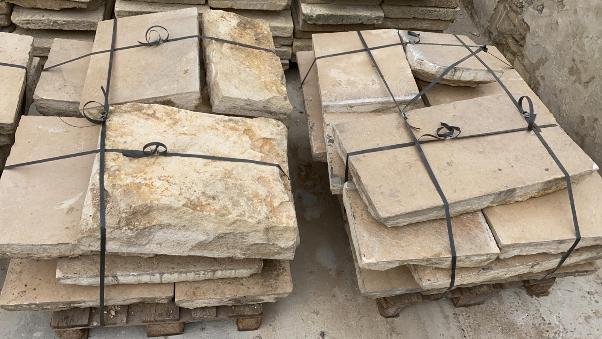
Antique Reclaimed Dalle de Bourgogne – Full Thickness
Installation Method
Installing antique reclaimed limestone calls for a slightly different approach from installing newly manufactured stone. The substrate must be clean, dry, level, and structurally sound, usually a well-prepared concrete or cement-based subfloor.
Before fixing begins, the floor should be dry-laid so that tonal variation, thickness differences, and the visual rhythm of the material can be judged properly.
For fixing, our preference at Paris Ceramics is generally to lay the flagstones antique face up using Ardex S16 Rapid Set, or in some cases into a sand and cement bed, depending on the application and the nature of the material. A full, solid bed is essential. We do not recommend spot fixing or dot-and-dab methods, as these can create hollow areas, weaknesses, and eventual cracking.
Cutting Reclaimed Limestone
Cutting must be sympathetic. The point is not to force reclaimed stone into an excessively crisp modern language, but to retain the visual logic of antique material.
A wet saw is usually the right tool where precision is needed, though in some cases a softer, more hand-worked edge is more appropriate.
This is where the importance of stone dressing comes in. The shaping and refining of stone is not simply a technical necessity. It is part of the craft that allows the material to retain both its structural integrity and its visual truth.
Stone Dressing and Surface Preparation
Stone dressing is important because it is never only about appearance; it is the craft that allows stone to become both more beautiful and more usable, revealing colour, texture, and pattern while also making the material fit for its architectural purpose.
Through careful shaping, refining, and finishing, the stone gains clarity and character, but it also gains precision, allowing it to sit properly, join cleanly, and perform as it should over time.
That practical side is inseparable from the visual one. Well-dressed stone is easier to install, requires less forceful correction on site, and creates a more harmonious result because the material has already been understood before it reaches its final position.
The process begins with selection, inspection, and marking, then moves through rough dressing, finer refinement, and finally the choice of finish, whether polished, textured, or left with a more natural softness. In the best work, the dressing of the stone simply brings out what was already latent within it.
Joint Width and Grout Tone
Joint widths depend on the effect required. Some clients prefer tighter joints, while others want a broader joint that allows the rustic quality of the floor to breathe a little more.
We often favour our own grout mix to achieve a softer, more traditional tone: 1 part silver sand, 1 part builder’s sand (yellow), and 1 part white cement. This tends to produce a more sympathetic finish than many ready-mixed modern grouts when working with antique reclaimed stone.
Sealing Antique Reclaimed Stone
Sealing should be approached with understanding rather than routine. In certain situations, we recommend sealing the backs of the tiles before installation to help reduce the risk of efflorescence. Depending on the material, a breathable impregnating sealer may then be used before and after grouting to help protect the surface from staining and moisture ingress while still allowing the stone to behave naturally.
Maintenance and Patina
Maintenance is straightforward, but it does reward care. Regular sweeping is enough to remove most dust and loose particles, and from time to time the floor can be washed with a mild soap or neutral detergent. Many prefer a traditional black soap such as Savon Noir.
The rich patina of an old stone floor is not something applied so much as accumulated. That long process is what softens the surface, rounds the sharper edges, and alters the way light moves across the stone, giving it a depth that newer materials can only imitate.
Traditional Savon Noir, or soap flakes, has long been valued in this context because it cleans gently without stripping the stone of its character. Rather than acting harshly upon the surface, it can leave behind the faintest nourishing residue, helping to deepen colour and sustain that mellow, lived-in sheen which is part of old limestone’s appeal.
Unlike many heavily sealed modern floors, antique stone remains more porous and responsive to its environment. It breathes, absorbs, settles, and over time develops a surface richness that comes as much from life around it as from the stone itself.
In France, there is a certain joie de vivre around this sort of wear, where a fuss-free mop-up after spillages of wine, cheese, olive oil, or whatever else the day has brought will, in time, become a discolouration that tells the accumulated stories of the surface.
That is also why maintenance needs a certain restraint. Harsh or acidic cleaners, including vinegar, can strip away the softness and protective surface that age has built, leaving the stone rougher, flatter, and more vulnerable. Old stone does not ask for aggressive treatment. It asks to be cared for in a way that allows its patina to continue deepening rather than being erased.
With the right installation and sensible maintenance, an antique reclaimed limestone floor will continue not only to endure, but to develop further depth.
Sustainability, Creative Reuse and Project-Led Solutions
A floor that has already endured for centuries does not need to be treated as disposable simply because it has reached a new phase of its life. To reclaim and reuse antique limestone is to recognise the value already held within it: the material itself, the labour that shaped it, the years that have deepened it, and the fact that true quality rarely benefits from being replaced for the sake of replacement alone.
At Paris Ceramics, environmental responsibility is not separate from craft, sourcing, or design judgement. It sits within them. We are committed to reducing waste through reuse and recycling wherever possible, to reducing energy use across the business, and to sourcing responsibly where practicable, because sustainability is in essence the cumulative effect of many careful decisions made well.
To get the most out of reclaimed flooring, each constraint or limitation has to be approached as an opportunity for intelligent reuse.
For example, some pieces are not suitable for reuse as full floor flagstones, whether because they are broken, reduced in size, or arise as offcuts from the preparation of larger antique material. That does not mean they lose their value. On the contrary, it is precisely here that another kind of possibility begins.
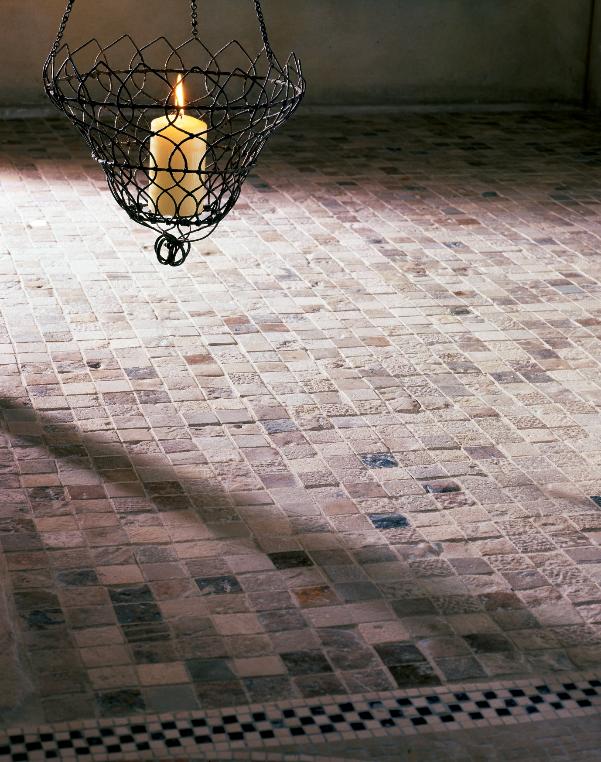
Dalle de Bourgogne Mosaic - Detail
Antique Bourgogne Mosaic
One example is our Antique Bourgogne Mosaic, produced in circa 3 x 3 cm tesserae and mesh-backed on 30 x 30 cm sheets. It allows the top surface of antique Dalle de Bourgogne to become a different kind of flooring option, or to continue into smaller decorative fields such as shower surrounds, kitchen splashbacks, and other areas where a more intricate or atmospheric treatment is required.
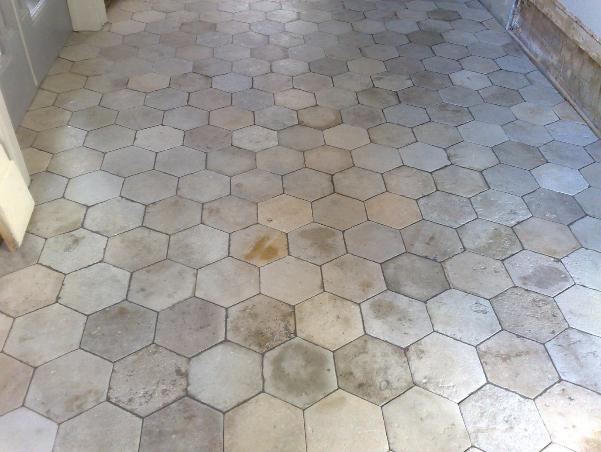
Grey Barr Hexagon Flooring
Antique Grey Barr Hexagons
The same spirit of adaptation applies elsewhere. Rather than thinking only in terms of standard modules, Paris Ceramics works with architects and designers to explore what the material can become. An offcut may find a new life not only as mosaic, but as a brick format, a herringbone, or a more patterned floor.
Antique Reclaimed Grey Barr, for example, can also be cut into hexagons, allowing specifiers to work with a more geometric layout while retaining the grey tonality, patina, and visual weight of the original reclaimed stone. What matters is not novelty for its own sake, but the flexibility to create solutions that remain materially truthful while meeting the needs of a particular project.
That, ultimately, is where sustainability and creativity meet. At Paris Ceramics, the approach is both versatile and project-led. Materials may have their limitations, but within those limits there is often far more room for invention than one might first imagine. By working closely with architects, designers, and clients, it becomes possible to transform apparent constraints into opportunities, and to carry antique material forward into new forms without losing the depth, character, and authority that made it worth preserving in the first place.
Paris Ceramics Case Studies
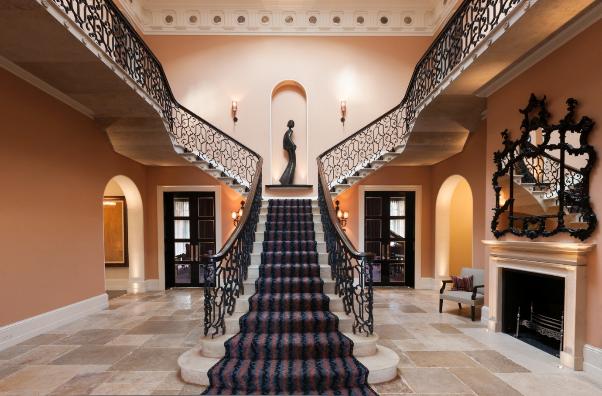
Ewhurst Park – Grand Hall, Antique Reclaimed Dalle de Bourgogne Floor
Ewhurst Park, Basingstoke
A recent example of how these materials live in a real design setting can be seen at Ewhurst Park, Basingstoke.
At Ewhurst Park, an historic 925-acre estate near Basingstoke in Hampshire, Paris Ceramics partnered with Seldom Scene Interiors in the USA for clients Mr and Mrs Cohen, working alongside main contractor Symm in the UK.
Our hard-surfaces package spanned the grand hall, hallways, cantilevered staircase and landings, all bathrooms, both kitchens, and the full wellness suite, including the swimming-pool interior lining, surround flooring, columns and grills, as well as the changing area and spa.
We supplied and fabricated a rich palette of materials, including antique reclaimed Dalles de Bourgogne, white refined limestone; custom hand-painted ceramic tiles and Pierre Victoire Historique.
While outside the scope of the three stones discussed in this project, it is worth mentioning a particular challenge in this project: the Pierre Victoire Historique.
As an exclusive Paris Ceramics product, it was developed from our knowledge of what truly antique floors look like, but its visual point of departure is inspired by the deep black Belgian stone known as Pierre de Mazy.
What made that material so distinctive was not only its almost lacquered depth of black, but its rarity: it belonged to a very limited Wallonian stone tradition whose older quarry sites have largely fallen silent, leaving only a narrow surviving lineage in the wider Noir de Mazy family. In Pierre Victoire Historique, that reference is not copied literally, but translated into a surface with the same density, sobriety, and historical gravity that gave those Belgian black floors their enduring power.
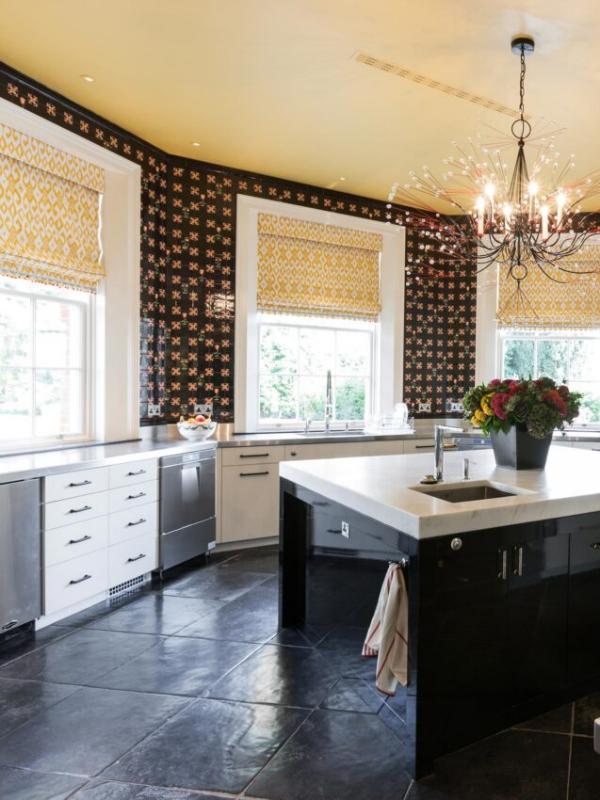
Pierre Victoire Historique - Antiqued and Distressed Stone at Ewhurst Park
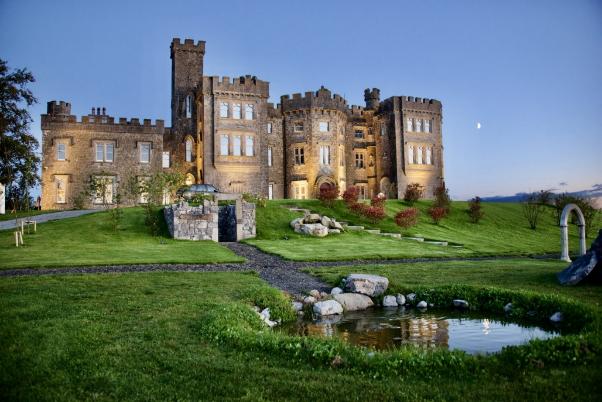
A Gem on the Emerald Isle – Killua Castle
Killua Castle, Ireland
A more unexpected setting for Dalle de Bourgogne (supplied and installed by Paris Ceramics) can be found at Killua Castle in County Westmeath, where reclaimed French limestone meets the long afterlife of an eighteenth-century Irish house. The estate was first granted to Captain Benjamin Chapman in 1657, but the present house belongs to a later chapter: in 1784, Sir Benjamin Chapman, 1st Baronet, built the first incarnation of the existing mansion, designed by Thomas Cooley.
By the time Allen Sanginés-Krause first encountered Killua in 1999, however, it had become little more than a romantic ruin, abandoned for decades and requiring a restoration of unusual scale and patience. What makes the project so compelling for architects and designers is precisely that sense of return. Over the course of 21 years, the house was not merely refurbished, but carefully brought back from near-ruin into meaningful contemporary life.
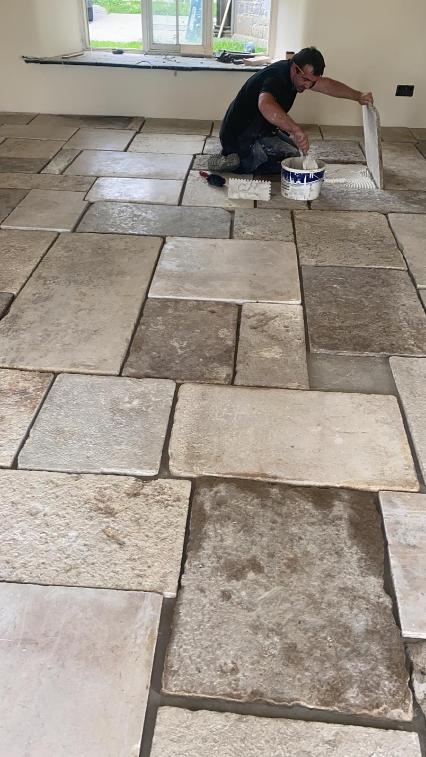
Antique Bourgogne First Cut 3cm Thick Limestone Being Dry-Laid and Installed – Chapel, Killua Castle
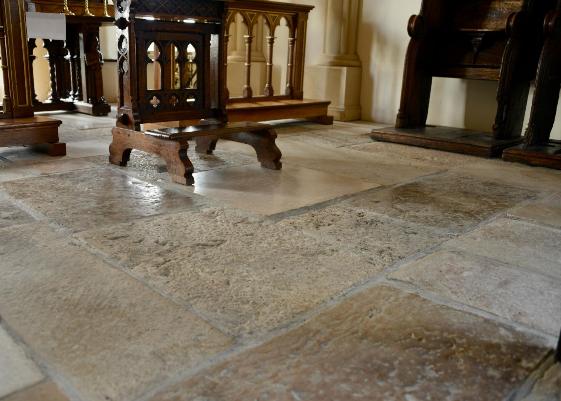
Antique Reclaimed Dalle De Bourgogne – Chapel floor, Killua Castle
In that setting, our antique Dalle de Bourgogne floor reads not as decorative nostalgia, but as an architectural material with enough weight, irregularity, and historical gravity to hold its own within a house of this scale. The result is not a period pastiche, but something more convincing: an old-world surface placed within a project that understands that restoration is never about freezing time, but about giving it another life.
We are so proud of our work at Killua Castle that we could not resist featuring the master bathroom on our homepage, where a custom Roman mosaic, a solid carved Carrara marble bathtub, and other carefully composed details reflect the same commitment to material richness, craftsmanship, and historical atmosphere that shaped the project as a whole.
The Paris Ceramics View of Reclaimed Stone
From the very early days, reclaiming and relaying antique terracotta and limestone became a consuming interest for Paris Ceramics, because we see reclaimed flooring as never having been a passing trend or decorative sideline. It sits close to the foundations of how we learned to see surfaces in the first place: not as mere products to be owned, but as pieces of history to be curated.
Each floor is acquired individually, then carefully cleaned, sorted, and interpreted so that it can live properly in its new setting. That process is part of what makes our approach design-led rather than stock-led. We are not interested in old materials as salvage in the abstract. We are interested in how they will live in a room, how they will settle into a project, and how their history and elegance can be carried forward with conviction.
And yet, antique reclaimed stone flooring, as well as aged or distressed stone, are only two parts of a much wider reclaimed world. In future blogs, we will return to other stone families including antique marble, Jerusalem stone, York stone, and terracotta, each with its own distinct language and architectural role. For us, that wider conversation remains endlessly compelling, because the best reclaimed floors do more than just survive. They continue to speak, and our task at Paris Ceramics is to help them do so beautifully.
CPD Template for Architects
CPD Template for Architects
Logging This as CPD
If relevant to your role, current projects or wider professional development, this article may be recorded as unstructured CPD.
Suggested Core Topic
Specification and application of antique reclaimed French limestone flooring in contemporary architectural projects
Suggested Learning Format
Self-directed reading
Estimated Reading Time
27-30 minutes
This Article Covered:
- The definition and architectural relevance of antique reclaimed French limestone flooring
- The distinction between antique reclaimed, second-face / second-cut, and aged or distressed stone
- The material and specification differences between Dalle de Bourgogne, Antique Reclaimed Grey Barr, and Antique Reclaimed Blonde Barr
- Typical formats, dimensions, and thicknesses of the three main stone families
- The role of second cuts, mosaics, and reworking in design and budget-conscious specification
- The importance of batch selection, one-off floors, and pre-approval in reclaimed stone procurement
- Considerations around heritage law, traceability, and ethical reclamation
- Practical installation guidance including substrate preparation, cutting, stone dressing, jointing, grout mixes, sealing, and maintenance
- The relationship between reclaimed stone, sustainability, and intelligent reuse
- Project examples including Ewhurst Park and Killua Castle, showing reclaimed limestone in serious architectural settings
Suggested CPD Record Summary
This article developed my understanding of antique reclaimed French limestone flooring as a specification category, focusing on provenance, material identity, practical build-up considerations, batch variability, heritage compliance, and installation logic. It clarified the differences between Dalle de Bourgogne, Antique Reclaimed Grey Barr, and Blonde Barr, and showed how reclaimed stone can be integrated into contemporary projects with both technical rigour and architectural sensitivity.
Suggested Reflection
How might reclaimed limestone affect my approach to specification where authenticity, material depth, floor build-up, or phased availability are critical? In what kinds of projects would batch variability and second-face options be an asset rather than a constraint?
Please Note
This content is intended for independent professional learning and should not be treated as accredited CPD unless expressly stated otherwise.
CPD Template for Interior Designers
CPD Template for Interior Designers
Where relevant to your professional practice, this article may be useful to log as self-directed or unstructured CPD.
Suggested CPD record
Date completed: [DD/MM/YYYY]
Activity title: Antique Reclaimed French Limestone Floors
Provider / publisher: Paris Ceramics
Format: Online article / self-directed reading
CPD category: Unstructured CPD
Estimated Reading Time: 27-30 minutes
Link: [Insert article URL]
What Did You Learn?
This article explored how antique reclaimed French limestone flooring can be understood and specified with greater confidence. It covered the distinctive character and practical differences of Dalle de Bourgogne, Antique Reclaimed Grey Barr, and Blonde Barr; explained how provenance, patina, and batch variation affect selection; and outlined how reclaimed floors are installed, maintained, and sometimes reworked through second cuts, mosaics, and alternative formats such as hexagons. It also clarified the difference between genuine reclaimed stone and newly aged or distressed stone.
Why Is This Relevant to Your Practice?
For interior designers, the article is relevant because it connects material storytelling to real project decisions. It shows how antique limestone can shape atmosphere, rhythm, and spatial character, while also requiring practical judgement around quantity, variation, layout, floor height, and budget. It is especially useful when designing interiors that need historical depth, visual softness, and authenticity without losing control of composition or specification.
Actions / Follow-up
- Review whether reclaimed limestone may be suitable for current or future projects requiring strong material narrative
- Consider where one-off floors, second-face options, or hexagonal recuts might support a design concept
- Apply more careful scrutiny to batch selection, approval processes, and floor format when sourcing reclaimed material
- Revisit the Paris Ceramics reclaimed stone collections and project examples for future specification reference
Please Note
This content is intended for independent professional learning and should not be treated as accredited CPD unless expressly stated otherwise.