

A Paris Ceramics Guide to Antique French Terracotta Flooring
Overview
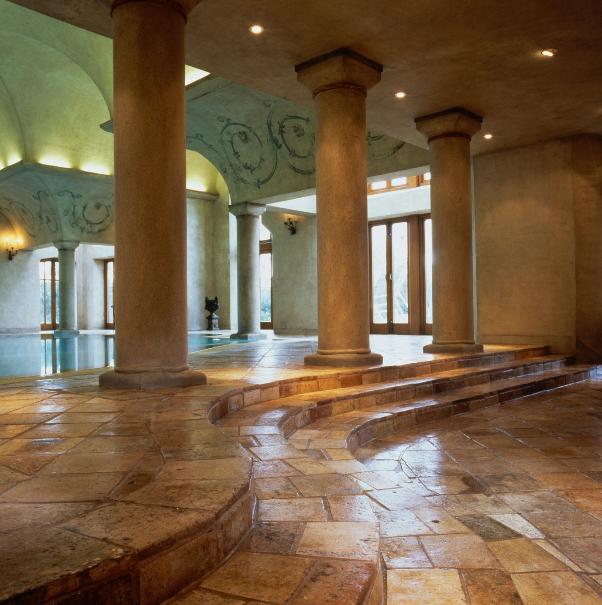
Antique Blanc Rose Terracotta Flooring – A Paris Ceramics Project
For Architects, Interior Designers and Project Teams
At Paris Ceramics, so much of what we do has you in mind. We know professional readers need more than attractive editorial. You need well-researched material insight that can support specification, spark design ideas, and add value to your CPD record. So we have done the research for you and turned that knowledge into something clear, useful and easy to apply.
To make that value immediate, we have also included two CPD-friendly templates at the end of the article: one for architects and one for interior designers. They are designed to help you log the learning quickly and with minimal effort.
We see architects, interior designers and project teams as important long-term partners and collaborators in the way we work, think and create.
Estimated Reading Time: 22-25 minutes
Antique Red Terracotta Floor
A Paris Ceramics Guide to Antique French Terracotta Flooring
Antique French terracotta flooring has a particular kind of presence. It is warm, certainly, but its appeal reaches beyond colour, as these are reclaimed clay floors shaped by region, hand, kiln, use and time. Their beauty lies in the slight irregularity of the surface, the movement of tone from tile to tile, and the quiet evidence of earlier rooms, earlier hands and earlier lives.
At Paris Ceramics, we approach antique reclaimed terracotta as both a historic material and a serious architectural surface. This guide looks at how antique French terracotta is made, how it varies, how to read its surface, where it works best, and how it should be specified, installed and cared for in contemporary interiors.
What Is Antique Reclaimed French Terracotta?
The term antique reclaimed French terracotta refers to terracotta tiles salvaged from old buildings in France, then carefully cleaned, sorted and prepared for new architectural use.
At Paris Ceramics, antique reclaimed terracotta is associated with period buildings in the south and west of France, often with an age of at least 150 years. It is defined not only by colour or rustic appearance, but by provenance, firing history, hand-making and the marks of use.
Many of these antique terracotta tiles were moulded by hand and fired in wood-burning kilns, and it is that older method of production that helps explain their nuance. Antique terracotta is rarely perfectly even in size, depth or tone. It tends instead to show slight undulations, softened arrises, subtle bowing, and colour movement ranging from warm yellows and ochres to pinks, reds, creams and deeper earthy notes.
To better understand the topic, it is worth noting that Antique French terracotta flooring brings together two kinds of history. The first is material history: clay dug from a particular region, shaped by hand, fired under the unstable conditions of an old kiln. The second is human history: a floor that has already belonged to kitchens, halls, farm buildings, manors and domestic rooms, carrying the slow polish of long use within its surface.
A reclaimed terracotta floor is not just old-looking. It is old, and its beauty lies partly in the fact that time is not being imitated, but is already present.
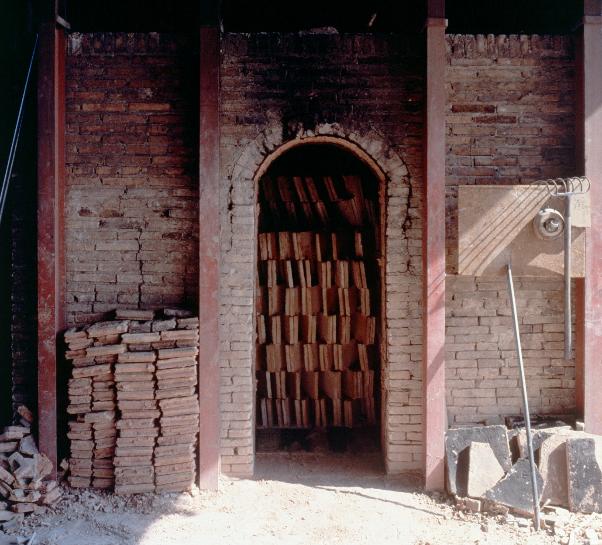
Traditional Arabesque Kiln for Firing Terracotta Tiles
Clay, Kiln and Format
Terracotta is sometimes spoken about as though it were a single material mood: warm, rustic, red. In reality, old French terracotta is far more regionally and materially specific than that. Its colour, density, texture and surface character are shaped by the clay body, the way the tile was moulded, the firing conditions, the kiln atmosphere, and the life it has lived since.
Clay and Kiln
The word terracotta literally means baked earth, and that simple word is an apt description, since these floors begin with local clay, not with an industrial recipe. The mineral character of that clay affects colour, the degree to which it was sieved affects texture, and the hand that pressed or shaped it affects the surface. The kiln then gives the clay its final range of colour, density and depth.
The technique of wood-firing gave antique French terracotta much of its visual complexity. Older kilns did not create the absolute uniformity expected from modern manufacturing, heat moved unevenly, and smoke, flame and oxygen varied across the firing chamber. Some tiles emerged paler, some richer, some more pink, some more ochre, some deeper and more russet. An antique terracotta floor should therefore be read not as a flat field of one colour, but as a quiet orchestration of related tones.
Before turning to the Paris Ceramics French terracotta families themselves, the vocabulary of these old floors is worth clarifying. Terms such as tomette, parrefeuille, hexagon and cabochon do more than describe shape; they explain how these French terracotta floor tiles behave architecturally.
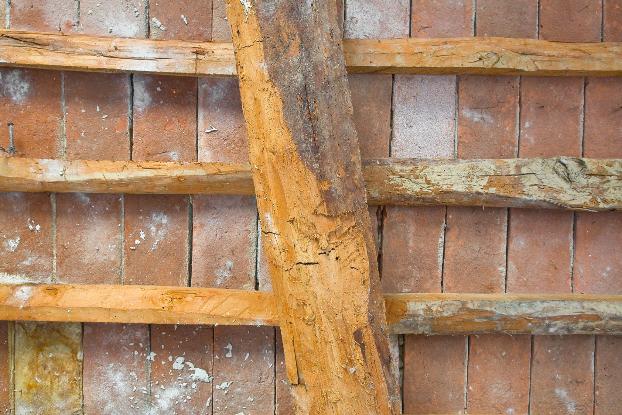
Antique Parfeuille Ceiling Underlay
Tomettes and Parrefeuille
Format is equally important. In France, the word tomette is often used for smaller terracotta floor tiles, especially hexagonal examples, though square and other forms also exist. These tiles are closely associated with French domestic interiors, from country houses and farm buildings to kitchens, corridors and upper rooms. Their scale gives a floor intimacy, while their irregularity keeps the sequence from becoming mechanical.
Parrefeuille introduces a longer and more directional reading. These rectangular clay tiles were used especially in the south of France, where their proportions could create floors of great simplicity and quiet architectural movement.
The term parrefeuille itself is worth pausing over. In French building language, it usually refers to a thin terracotta brick or flat clay tile, used not only for floors, but also in ceilings, roof underlayers and wall construction, as seen in the image above. The word is often understood as suggesting a kind of protective sheet tile: pare, to protect or shield, and feuille, a leaf or sheet.
In many parts of southern France, one of its most atmospheric traditional uses was between timber joists. Thin terracotta tiles were laid flat between the beams as a lightweight infill, then finished above with lime, screed or flooring. Seen from below, the effect is quietly beautiful: a warm clay plane held within timber, matte, softened and almost glowing.
When parrefeuille is reclaimed for flooring, that architectural memory remains part of its character. It belongs to a broader southern French building tradition in which clay was used as structure, protection, surface and atmosphere all at once.
Antique Yellow (Jaune) Floor with Cabochons
Hexagons, Octagons and Cabochons
Hexagonal (six sides) and Octagonal (eight sides) tiles have a completely different feel. Their geometry is more overt and recognisable. It gives a room historic structure without needing decorative pattern in the usual sense. The shape itself becomes the ornament.
Cabochon layouts belong to this same language of geometric floor-making. In their most familiar form, they use larger octagonal tiles with small contrasting square inserts, known as cabochons, set between them. The effect is more articulated than a plain square or hexagonal field, but still restrained, as if it were a measured punctuation of the floor rather than a decorative pattern imposed upon it. Where hexagons create continuous honeycomb rhythm, cabochon layouts introduce a quieter beat: tile, insert, tile, pause.
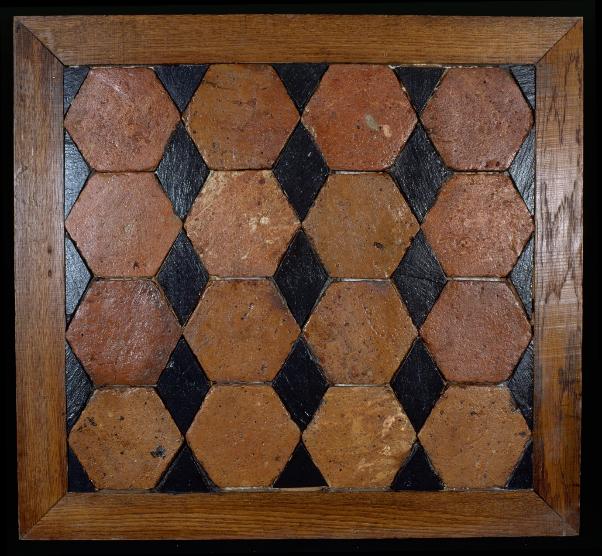
Antique Pink Hexagonal & Octagonal Terracotta with Slate Keystones
One-Off Floors and Customisation
This same sensitivity to proportion and sequence can also inform one-off and customised floors. Where a particular antique terracotta batch has the right quantity, character and consistency, Paris Ceramics can interpret it more individually, introducing octagons, hexagons or other cut formats as part of a wider floor design. This is distinct from the antique hexagonal products described below; here, the emphasis is project-led.
There is also room for more tailored intervention. Custom-cut slate keystones, for example, can be introduced to punctuate the warmth of antique clay with a darker, more architectural note. Used carefully, these details can help a reclaimed terracotta floor feel both historic and composed.
Antique terracotta should therefore never be specified only by colour. A red square, a yellow hexagon and a long parrefeuille may all belong to the same broad clay tradition, but they create very different spatial effects. One feels domestic and familiar, another feels directional and architectural, while another introduces a more formal historic geometry.
At Paris Ceramics, this is part of the pleasure of working with reclaimed terracotta. The material is never only material. It is proportion, sequence, colour, texture, history and room atmosphere all at once.
Paris Ceramics Antique Terracotta Families
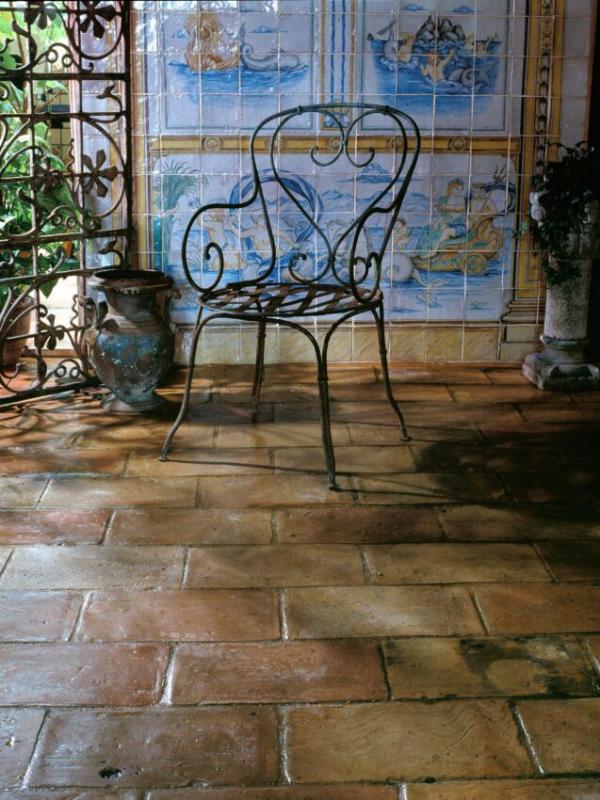
Antique Parrefeuille Floor
Antique Parrefeuille Terracotta
Antique Parrefeuille Terracotta is one of the most distinctive formats in the reclaimed French terracotta world. Its rectangular form immediately changes the architectural reading of a floor. Instead of the compact rhythm of a square tomette, parrefeuille creates a longer, more directional field, one that can feel rustic, monastic and quietly elegant.
At Paris Ceramics, Antique Parrefeuille tiles are hand selected from the Languedoc region of France. They were handmade and fired in wood-burning kilns, a historic production method associated with these earlier tiles rather than ordinary modern manufacture. Made from local earth, roughly sieved to give varied texture and beautiful pink and ochre tones, these tiles are up to 150 years in age.
Sizes, Thickness and Specification
At Paris Ceramics, Antique Parrefeuille tiles are approximately 20 x 35 cm, or 8” x 14”, with a thickness of 2.3 to 3 cm, or 1” to 1¼”, though they can vary in size. The longer format gives the floor its linear and architectural character.
Antique Blanc Rose Terracotta
Antique Blanc Rose Terracotta is defined by rarity and tone, and is among the rarest of terracottas, found only in a very restricted area of France. Hand-moulded square tiles in delicate tones of cream, pink and soft red make this a highly individual and unusual floor.
The tiles were not made after the nineteenth century, and many of the floors sourced date as far back as the seventeenth century. Individual tiles may carry the maker’s original stamped monogram, a detail that gives the material particular intimacy. In Blanc Rose, one is not simply looking at antique terracotta in a general sense, but at a specific and highly refined expression of it.
Sizes, Thickness and Specification
At Paris Ceramics, Antique Blanc Rose is available in approximate sizes of 16 x 16 cm, or 6” x 6”, 20 x 20 cm, or 8” x 8”, and hexagons. Antique terracotta usually ranges in thickness from around 2.5 to 3 cm, or 1” to 1¼”. Its distinction lies in the way those formats are held within such a rare and delicate tonal family: a floor specified for refinement, rarity and unusual chromatic softness.
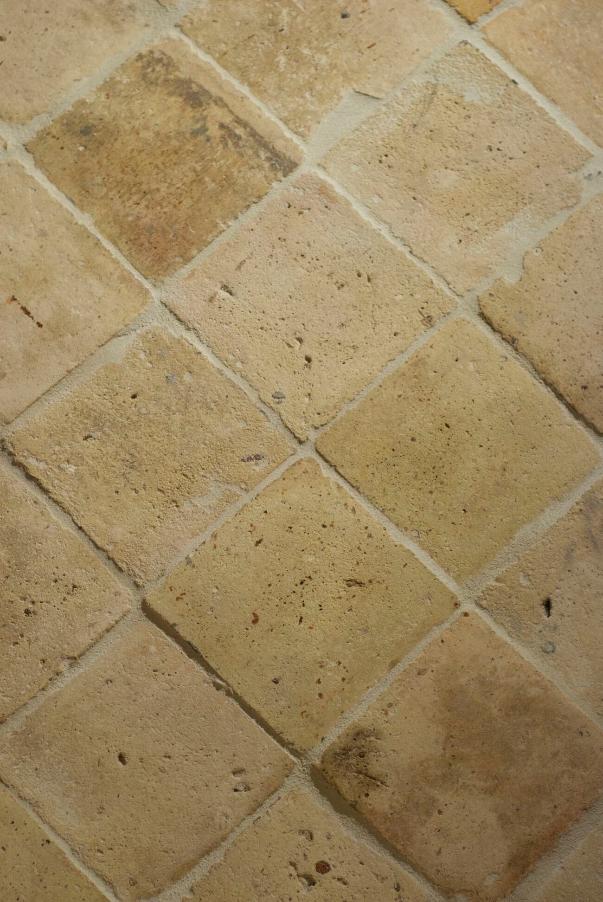
Antique Yellow (Jaune) Floor - Detail
Antique Yellow (Jaune) Terracotta
Antique Yellow (Jaune) Terracotta introduces a lighter and more sun-washed register. These are actual reclaimed antique handmade tiles from Central and Southern France, and they belong to the broader world of French clay floors whose character comes from hand making, age and local earth rather than uniformity.
The Antique Yellow Terracotta we usually work with are formed of small rectangles, giving it a different visual sequence from square or hexagonal examples. Its appeal lies in its lighter, more open character, especially when compared with the deeper red terracotta families.
Sizes, Thickness and Specification
The tile sizes are commonly 15 and 20 cm, or 6” and 8”, with thickness varying around 3 cm, or 1¼”. Antique Yellow Terracotta is used primarily indoors. It may be used outside only in non-freeze areas. Its specification rests not only on colour, but also on compact rectangular format and practical suitability.
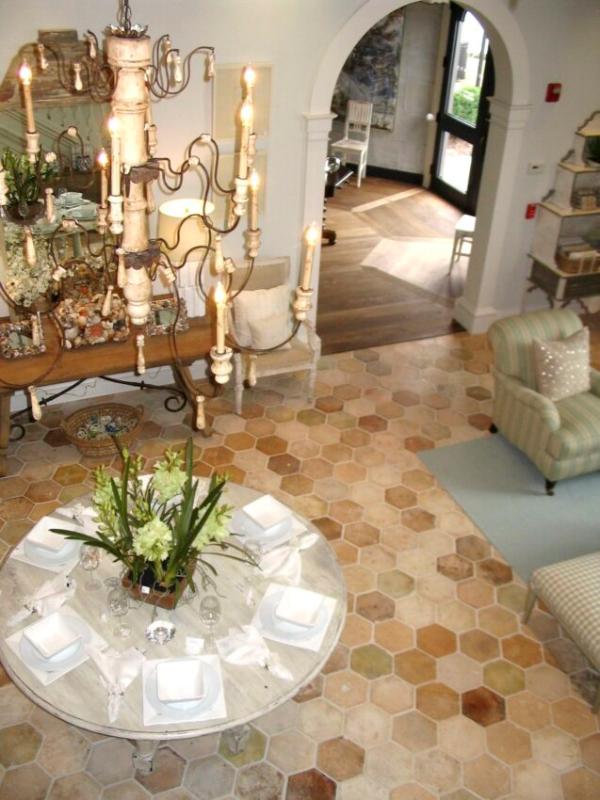
Antique Yellow Hexagonal Flooring
Antique Yellow Hexagonal Terracotta
Antique Yellow Hexagonal Terracotta combines the lighter yellow tonal family with one of the most recognisable historic clay formats. Handmade clay tiles from the Loire Valley, Bordeaux and Provence regions of France, this terracotta can be up to three hundred years in age.
Typically, the tile is reclaimed from country houses, though it is found in a wide range of structures. The yellow tonal register keeps the floor open and warm, while the hexagonal module gives it a more formally resolved historic geometry.
Sizes, Thickness and Specification
Antique Yellow Hexagonal Terracotta is usually found in 15 or 20 cm, or 6” or 8”, tiles, but like all handmade antique materials, size can vary. The thickness varies around 2.5 cm, or 1¼”.
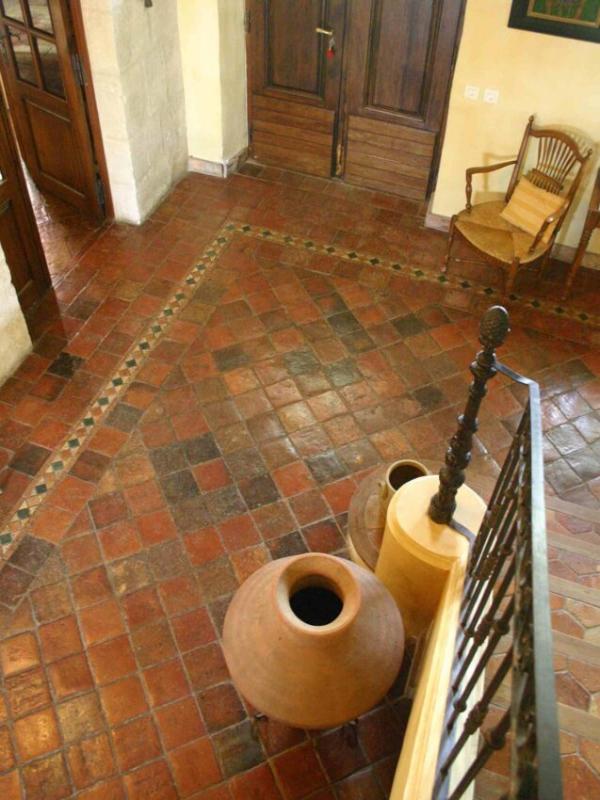
Antique Red Terracotta Floor
Antique Red Terracotta
Antique Red Terracotta represents one of the great classic expressions of reclaimed French clay flooring. These terracotta tiles are actual antique reclaimed handmade clay tiles from the Loire Valley, Bordeaux and Provence regions of France.
They were traditional materials used for floor covering in many rooms of a building. Moulded by hand and fired in wood-burning kilns, these tiles carry the worn ease associated with old European country floors. Antique Red Terracotta can be up to three hundred years old, and its colouration varies from rustic pinks to deep reds, giving it a richness and breadth that a flatter modern tile rarely achieves.
Sizes, Thickness and Specification
The most common sizes are 15 and 20 cm, or 6” and 8”, tiles, though larger pieces have also been found. Thickness will vary at around 2.5 cm, or 1¼”, nominal. Its colour ranges from rustic pinks to deep reds, and that tonal variation forms part of the specification.
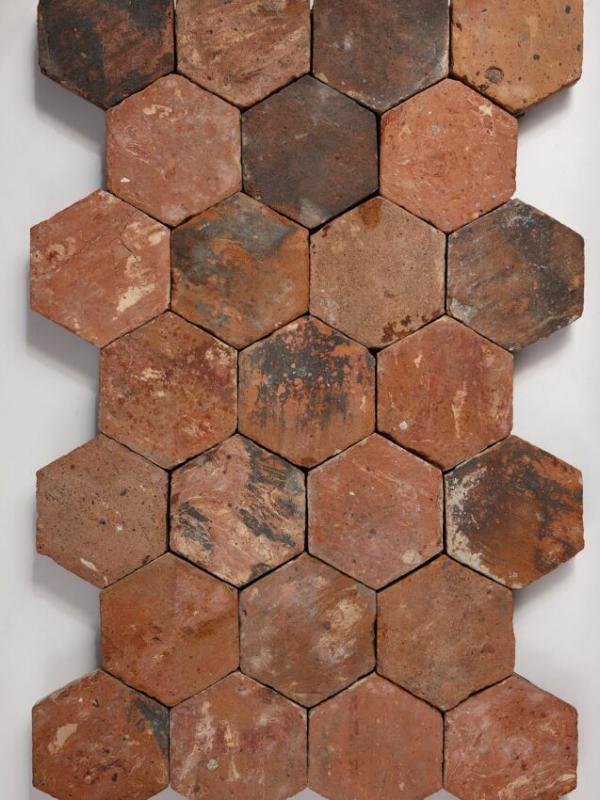
Antique Red Hexagonal Floor - Detail
Antique Red Hexagonal Terracotta
Antique Red Hexagonal Terracotta combines one of the richest terracotta colour families with one of the most recognisable historic modules. Handmade clay tiles from the Loire Valley, Bordeaux and Provence regions of France, this terracotta can also be centuries old.
Typically, the tile is reclaimed from country houses, but it is found in a wide range of structures. Where a square red terracotta floor may feel more relaxed and domestic, a red hexagonal floor tends to feel more visibly historic and composed. It has a stronger graphic presence, but because the tiles are antique and handmade, that geometry remains softened by wear, tone and irregularity.
Sizes, Thickness and Specification
Antique Red Hexagonal Terracotta is usually found in 15 or 20 cm, or 6” or 8”, tiles, but like all handmade antique materials, size can vary. The thickness varies around 2.5 cm, or 1¼”. Its Antique Reclaimed finish and hexagonal format suit interiors seeking a stronger sense of historic structure.
Across these families, the differences are not only chromatic or geometric, as they are also legible in the surface itself.
How a Connoisseur Reads Antique Terracotta
A connoisseur does not look at antique terracotta only for colour, as the deeper reading lies in surface, edge, density, firing, wear, proportion and the small irregularities that reveal how the tile was made and how it has lived.
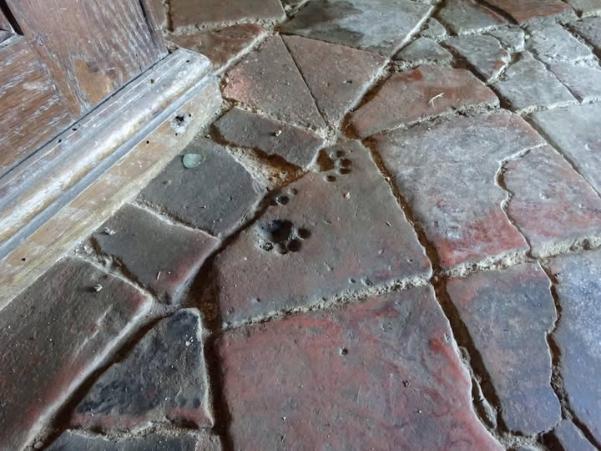
Probably the paw prints of a chubby medieval cat preserved in 12th-century floor tiles at St. Peter's Church in Wormleighton, England
Traces of Time
Some tiles are remarkable not only because they are old, but because they preserve a moment of accidental life within the clay itself.
As can be seen in the photo above, a cat appears to have walked across the surface before the tile was fired, leaving paw prints that were then fixed permanently by the kiln. What might once have been an ordinary interruption in the workshop has become, centuries later, part of a tile’s historical charm.
For a designer, architect or collector, details like these are more than curiosities. They remind us that antique terracotta was made in a world of human hands, open workshops, animals, weather, earth and fire, giving the floor something a reproduction can only imitate - the unplanned poetry of time.
Variation, Not Defect
A connoisseur also understands that variation in antique terracotta is not simply something to be tolerated as much as it is often the very point behind choosing to work with it.
A reclaimed terracotta floor may contain lighter and darker tiles, flatter and more textured tiles, slightly different thicknesses, irregular edges, minor chips, old marks and subtle colour inconsistencies. While in a poor installation, this can look chaotic, in a well-selected and well-laid floor, it becomes visual contrast and depth.
The skill here lies in interpretation and positioning, meaning that antique terracotta must be arranged so that difference between tiles feels natural and balanced. The floor should not look over-curated, but neither should it look accidental, feeling as though the room and the material have come to an understanding.
That is the connoisseur’s reading: not merely “is this tile perfect?”, but “does this floor have life, coherence, authenticity and grace?”
Newly Made Terracotta Floors
The wider market often blurs categories that should be kept distinct.
Some products are genuine antique reclaimed terracotta, lifted from old buildings and reintroduced into use. Some are new handmade terracotta designed to carry a reclaimed or time-softened feel. Others are terracotta-effect porcelain, which reproduces something of the colour and visual warmth of old clay while changing the maintenance and performance profile quite significantly.
New handmade terracotta can be an intelligent solution where one wants tonal variation and artisanal character with greater continuity of supply.
Terracotta-effect porcelain can be useful where lower porosity, easier maintenance, reduced thickness, or certain performance requirements are stronger priorities.
But these categories should not be confused. Where antique reclaimed terracotta is a material with a past, newly made terracotta floors are a contemporary interpretation that uses traditional techniques to give a floor a centenary feel.
Terracotta-effect porcelain, on the other hand, is a visual translation into another technical category altogether. The key is not to pretend that all these materials are the same; it is to understand what each one can do, and to specify accordingly.
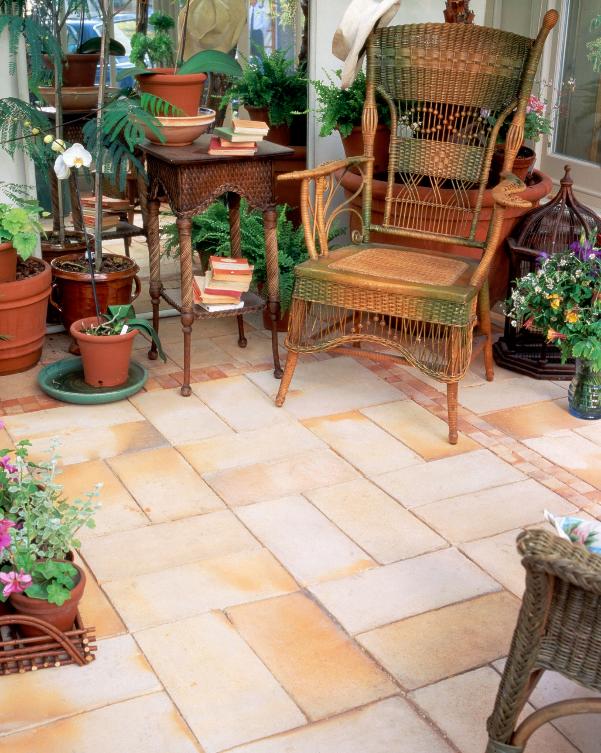
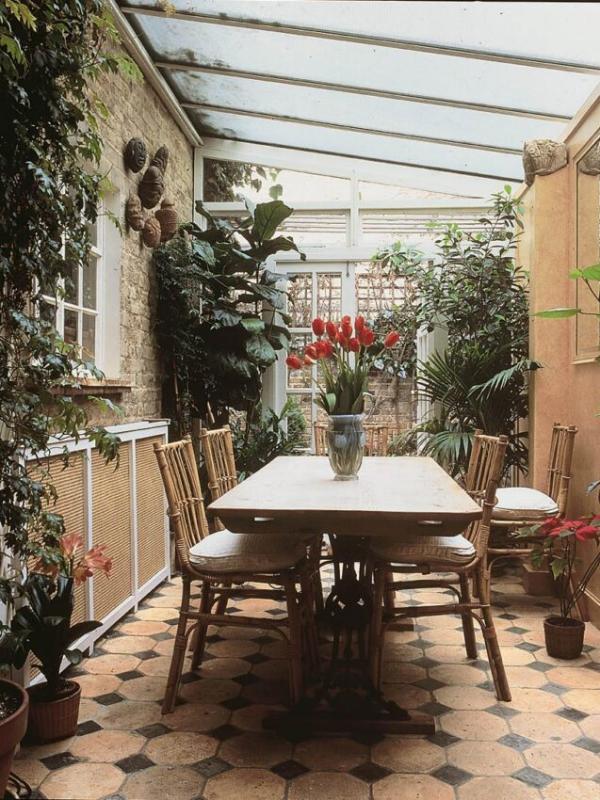
Conservatory in Santa Rufina Floor – A Paris Ceramics Project
A Note on Santa Rufina
While the antique terracottas remain central to the Paris Ceramics story, Santa Rufina occupies a different and useful position within the wider terracotta world.
Paris Ceramics had been searching for a readily available alternative to antique terracotta floors, and a lengthy process of research and experimentation culminated in this floor called Santa Rufina.
Santa Rufina sits adjacent to the antique terracotta family rather than inside it. Its value lies in offering a way to work with the warmth, depth and atmosphere of clay flooring where genuine antique supply may be too limited, irregular or project-specific.
Sizes, Thickness and Specification
The current product specification states a thickness of 2 cm. In practical terms, Santa Rufina should be understood as Paris Ceramics’ more readily available terracotta-floor alternative, developed in response to the finite nature and irregular availability of genuine reclaimed material.
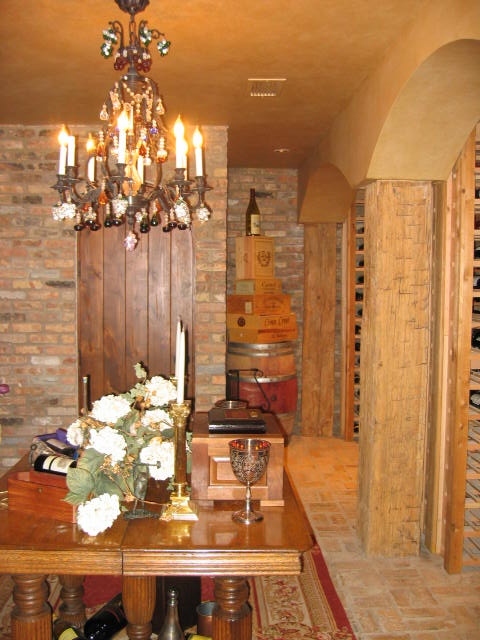
Kitchen in Antique Yellow (Jaune) Terracotta – A Paris Ceramics Project
Where Antique French Terracotta Works Best
Antique terracotta works best in rooms where warmth, movement and daily life are part of the brief. It is not a brittle or overly precious material. When properly selected and installed, it brings age, softness and architectural substance to spaces that are meant to be lived in.
It is especially suited to:
- Kitchens - where it softens cabinetry, warms stone worktops, and gives the room a more settled, lived-in character.
- Entrance halls, boot rooms and transitional spaces - where its durability, informality and historic surface make it feel naturally at home. Parrefeuille can be especially effective in passage-like spaces, while hexagons give a stronger sense of pattern and structure.
- Garden rooms and orangeries - where terracotta sits beautifully with plants, plaster, timber and natural light, creating a gentle threshold between house and garden.
- Dining rooms and informal living spaces - where it brings warmth without grandeur, making the room feel hospitable, tactile and quietly established.
- Bathrooms, cloakrooms and wet areas - possible, but only with careful specification. Sealing, slip resistance, grout choice, ventilation and maintenance expectations all need to be resolved properly.
- Contemporary interiors - where antique terracotta can introduce hand, history and subtle irregularity into spaces that might otherwise feel too exact or newly assembled.
A successful antique terracotta floor should feel as though it has found its next chapter, not as though it has been imposed as a nostalgic gesture.
Terracotta Floor Installation and Practical Suitability
Terracotta floor installation requires more care when the material is antique, reclaimed or handmade. The tiles are usually porous, historically irregular, and may vary in thickness, tone, edge condition and surface texture. A successful installation depends on preparation, dry-laying, sealing strategy, suitable adhesives or bedding, careful grouting and realistic expectations about variation.
Substrate, Sorting and Dry-Laying
Our recommendation is that the substrate should be clean, dry, flat, stable and suitable for the chosen fixing method. Any screed, concrete or existing base should be properly cured and free from dust, laitance, oils or movement before installation begins. Where underfloor heating is present, the heating system should be commissioned before tiling and then switched off during installation and sealing, following the relevant heating and adhesive manufacturer’s instructions.
Because reclaimed terracotta is not fully standardised, the tiles should be inspected and sorted before fixing. Dry-laying is strongly advised. This allows the installer and designer to assess colour distribution, thickness variation, surface wear, edge irregularity and the overall balance of the lot before anything is permanently fixed.
Tiles should be blended from different crates or pallets so that the finished floor feels naturally varied rather than grouped by colour, size or wear. Any particularly strong, pale, worn, bowed or irregular pieces can then be placed deliberately, used at edges, saved for cuts, or set aside if unsuitable.
Thickness, Build-Up and Fixing
Antique reclaimed terracotta can vary significantly in thickness, so finished floor heights, thresholds, door clearances, adjoining floors and underfloor heating build-ups should be reviewed before work starts. The installer may need to adjust the adhesive or bedding depth from tile to tile in order to achieve a stable, visually even finished surface.
At Paris Ceramics, we recommend fixing with an appropriate flexible tile adhesive or mortar system suited to the substrate, tile type and location. A full bed of adhesive is important. Hollow spots should be avoided because terracotta needs proper support beneath the whole tile, especially where pieces are thick, handmade or slightly irregular.
Some traditional or conservation-led projects may use lime-based or traditional bedding methods, but our advice is to treat this as a project-specific specification rather than a general rule. The fixing method should be agreed with the installer, adhesive manufacturer, architect or conservation specialist where relevant.
Cutting should be done carefully. Wet cutting may be used where precision is required, but tiles that become wet during cutting should be allowed to dry before fixing or sealing. Wet or saturated terracotta can be more vulnerable during handling and may also interfere with sealing or finishing.
Sealing Before Grouting
Terracotta is porous, especially unglazed, handmade or antique material. For that reason, Paris Ceramics recommends sealing or applying a pre-grout protective treatment before grouting. This helps reduce grout staining and makes grout residue easier to remove from the surface.
The exact sealer and method should be chosen for the tile, desired finish and location. Some systems use an impregnating sealer. Others use oil and wax finishes or other proprietary treatments. Whatever the system, testing on spare tiles or an inconspicuous area is recommended, because sealers can alter the tone, sheen or depth of terracotta.
The sealer must also be allowed to cure properly before grouting. Grout should not be applied until the pre-seal or grout-release layer is ready.
Jointing and Grouting
Joint width should be based on tile size, edge condition, format and variation. Handmade and reclaimed terracotta usually needs more tolerance than a machine-cut modern tile. We recommend allowing enough joint width to accommodate the natural irregularity of the batch rather than forcing antique material into an artificially tight modern grid.
Grouting should be carried out carefully and in small areas. Because terracotta is porous and textured, excessive grout spread over the tile face can be difficult to remove. For very open, absorbent or textured antique terracotta, careful pointing or controlled application is preferable to heavy slurry grouting across large areas.
Clean water, clean sponges and frequent water changes are important. Grout residue should be removed promptly, but without over-wetting the floor. The tiles should then be allowed to dry before the final sealing or finishing stages.
Grout colour should be chosen sympathetically. A harsh or overly modern grout can make an old terracotta floor look outlined and artificial. Softer, warmer or more traditional tones usually sit more comfortably with antique clay, but the exact choice should be tested against the actual floor.
Final Sealing and Finishing
After grouting and drying, Paris Ceramics recommends final sealing or finishing. The finish system should be suitable for the level of use, the room type, and the desired appearance. Kitchens, entrance halls and wet-adjacent areas may require a more robust protection strategy than low-traffic rooms.
Terracotta floor sealing should protect the floor without erasing its character. Antique terracotta should not be sealed into a plastic-looking surface unless that is specifically intended. The best finish is usually one that supports practical use while preserving the natural depth, texture and softness of the clay.
Future maintenance should follow the sealer manufacturer’s guidance. Harsh acidic or alkaline cleaners can damage finishes or alter the surface, therefore, mild pH-neutral cleaners, clean water and periodic resealing or re-waxing work best.
Underfloor Heating
Terracotta can be compatible with underfloor heating, provided the full build-up is properly designed. It is best to treat the heating system, screed, adhesive, tile thickness, movement joints and sealing system as one connected specification.
The heating system should be installed and commissioned correctly before tiling. Appropriate expansion gaps and movement joints should be allowed for, especially around perimeters and where heating cycles may cause expansion and contraction. Flexible adhesives and grouts are often the most suitable choice for tiled floors over underfloor heating, but the exact products should be confirmed with the adhesive and heating manufacturers.
The heating should usually be off during installation, sealing and grouting, and then brought back up gradually only after the adhesive, grout and sealers have cured. Sudden heat can drive moisture too quickly through the floor build-up and may contribute to cracking, debonding, staining or sealer failure.
For antique reclaimed terracotta, the tile thickness and irregularity should also be considered. Thicker tiles may affect heat-up times, although terracotta’s thermal mass can help retain and radiate warmth once heated.
Wet Areas and Exterior Use
Bathrooms, cloakrooms, utility rooms and wet-adjacent areas are possible, but require careful specification. Terracotta is porous, so sealing, grout choice, falls, ventilation, slip resistance and cleaning expectations all need to be considered. In genuinely wet zones, the substrate waterproofing and tanking should be dealt with by the installer or project professional before the tiles are laid.
Exterior use should never be assumed. Some terracotta is suitable only indoors or in non-freeze areas. Freeze-thaw exposure, saturation, drainage, tile porosity, firing temperature and installation method all affect performance. Paris Ceramics recommends assessing antique reclaimed terracotta product by product before specifying it outdoors.
Old terracotta can be robust and long-lived, but only when its porosity, variation and historic character are respected during installation.
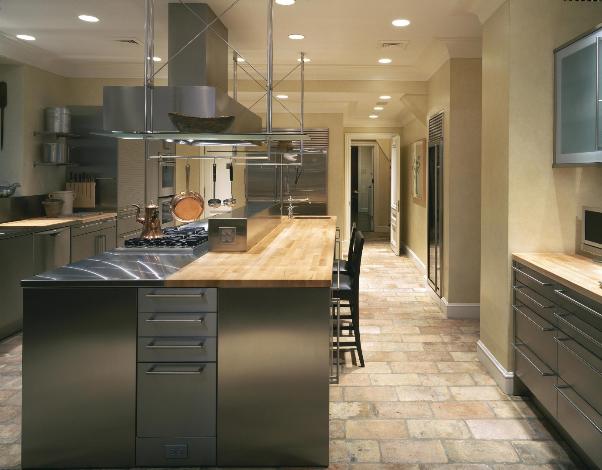
Kitchen in Antique Parrefeuille Terracotta – A Paris Ceramics Project
The Paris Ceramics Philosophy
From the very early days, reclaiming and relaying antique terracotta became a consuming interest for Paris Ceramics, because floors of this kind have never felt to us like a decorative sideline. They sit close to the foundations of how we understand surfaces at all: as materials shaped by region, use, craft and the quiet dignity of time.
Each floor is acquired individually, then carefully cleaned, sorted and interpreted so that it can live properly in its new setting. That process is part of what makes our approach design-led rather than stock-led. We are not interested in old materials simply because they are old. We are interested in how they will settle into a room, how they will shape atmosphere, and how their history can be carried forward without being sentimentalised.
That distinction is central in a market now filled not only with genuine reclaimed terracotta, but also with reclaimed-look terracotta and terracotta-effect porcelain. All can be useful in the right project. Yet a true antique floor remains categorically different, because its age is real, its variation is earned, and its authority comes from having already lived a long architectural life.
Antique terracotta is especially moving because it contains something profoundly architectural and something profoundly domestic at once. It belongs to halls and kitchens, farm buildings and manors, thresholds and rooms of daily life. It brings warmth, yes, but also structure, memory and material seriousness.
And that is why antique French terracotta flooring still feels alive underfoot. Not because it is quaint, but because it continues to speak in a language that architecture still understands: earth, fire, variation, wear, and the long afterlife of inhabitation.
Although this article focuses on antique French terracotta, it belongs to a wider Paris Ceramics conversation around reclaimed and historically resonant floors.
If you enjoyed this article, you may also find value in our other blogs about Antique and Aged French Limestone Flooring, or about English Flint. For architects and interior designers, these blogs may contribute to your self-directed CPD learning.
From time to time, we also work with antique terracotta and stone from other countries, such as Eastern Europe (which is more straw-yellow in tone), as well as reclaimed floors from Spain (ochre-red), Portugal (rose-red) and further afield. Each has its own, format, architectural memory and regional character, and each deserves to be understood on its own terms. We will return to some of these related material worlds in future guides.
If you would like to discuss suitable formats, room use, installation considerations, or how antique reclaimed terracotta might sit within a wider material scheme, contact us at Paris Ceramics for an initial conversation.
CPD Template for Architects
CPD Template for Architects
Logging This as CPD
If relevant to your role, current projects or wider professional development, this article may be recorded as unstructured CPD.
Suggested Core Topic
Specification and application of antique French terracotta flooring in contemporary architectural and interior projects.
Suggested Learning Format
Self-directed reading.
Estimated Reading Time
22-25 minutes.
This Article Covered
- The definition and architectural relevance of antique reclaimed French terracotta flooring.
- The role of provenance, local clay, hand-moulding and wood-firing in shaping the colour, texture, variation and character of old terracotta.
- The importance of French floor language, including tomettes, parrefeuille, hexagons, octagons, cabochons and customised floor layouts.
- The historical use of parrefeuille not only as flooring, but also as attic ceiling lining, roof underlayer and part of the hidden clay fabric of old southern French buildings.
- The visual and architectural differences between Antique Parrefeuille, Blanc Rose, Yellow, Yellow Hexagonal, Red and Red Hexagonal terracotta floors.
- The role of one-off and customised floors, including the possible use of custom-cut slate keystones to create a more project-led geometric composition.
- How to read antique terracotta through surface wear, kiln variation, softened edges, maker’s marks, accidental traces, paw prints, old mortar traces and patina.
- The distinction between genuine antique reclaimed terracotta, reclaimed-look terracotta, new handmade terracotta and terracotta-effect porcelain.
- The place of Santa Rufina as a more readily available terracotta alternative within the wider Paris Ceramics terracotta world.
- Practical considerations around build-up, substrate preparation, dry-laying, sorting, fixing, jointing, sealing and maintenance.
- The relationship between antique terracotta and underfloor heating, wet areas, interior suitability and cautious exterior use.
- The role of patina, variation, rarity, format and room context in the intelligent selection of reclaimed terracotta.
Suggested CPD Record Summary
This article developed my understanding of antique French terracotta flooring as a specification category, focusing on provenance, material identity, firing history, format variation, French floor terminology, category distinctions, connoisseurship, practical build-up, installation logic, sealing, maintenance and room suitability. It clarified the differences between several terracotta floor types within the Paris Ceramics range, including Parrefeuille, Blanc Rose, Yellow, Red and hexagonal variants, and showed how reclaimed clay floors can be integrated into contemporary architectural and interior projects with both technical rigour and material sensitivity.
Suggested Reflection
How might antique French terracotta flooring affect my approach to specification where warmth, material softness, floor build-up, rarity, visible patina or historic character are important? In what kinds of projects would variation, hand-made irregularity, reclaimed provenance and project-led format selection be an asset rather than a constraint?
Please Note
This content is intended for independent professional learning and should not be treated as accredited CPD unless expressly stated otherwise.
CPD Template for Interior Designers
CPD Template for Interior Designers
Where relevant to your professional practice, this article may be useful to log as self-directed or unstructured CPD.
Suggested CPD Record
Date completed: [DD/MM/YYYY]
Activity title: A Paris Ceramics Guide to Antique French Terracotta Flooring
Provider / publisher: Paris Ceramics
Format: Online article / self-directed reading
CPD category: Unstructured CPD
Estimated Reading Time: 22-25 minutes
Link: [Insert article URL]
What Did You Learn?
This article explored how antique French terracotta flooring can be understood and specified with greater confidence. It explained how provenance, local clay, hand-moulding and wood-firing shape the colour, texture, warmth and variation of old terracotta; introduced French floor terms such as tomette, parrefeuille, hexagon and cabochon; outlined the differences between Parrefeuille, Blanc Rose, Yellow, Red and hexagonal terracotta formats; clarified the distinction between genuine reclaimed terracotta, reclaimed-look terracotta, new handmade terracotta and terracotta-effect porcelain; and set out practical considerations such as floor build-up, dry-laying, fixing, jointing, sealing, maintenance, underfloor heating and room suitability.
It also introduced ways of reading antique terracotta more closely, including kiln variation, surface polish, softened edges, stamped marks, old mortar traces, accidental paw prints, visible patina and the wider role of variation in creating depth rather than defect.
Why Is This Relevant to Your Practice?
For interior designers, the article is relevant because it connects material storytelling to real project decisions. It shows how antique terracotta can shape atmosphere, colour, softness, spatial rhythm and historical character, while also requiring practical judgement around variation, build-up, finish, maintenance, rarity and application.
It is especially useful when designing interiors that need warmth, authenticity and visual ease without losing architectural control.
Actions / Follow-Up
- Review whether antique reclaimed terracotta may be suitable for current or future projects requiring warmth, material depth and visible patina.
- Consider where Parrefeuille, square, hexagonal, octagonal or cabochon-based terracotta formats might best support the intended rhythm and proportion of a room.
- Consider whether a one-off or customised floor, including the possible use of custom-cut slate keystones, could add a more resolved architectural character to a project.
- Apply more careful scrutiny to batch variation, joint width, sealing, underfloor heating compatibility and maintenance expectations when sourcing reclaimed terracotta.
- Revisit the Paris Ceramics antique reclaimed terracotta collection and Santa Rufina for future specification reference.
Please Note
This content is intended for independent professional learning and should not be treated as accredited CPD unless expressly stated otherwise.