

English Flint: From Prehistoric Tool to Architectural Surface | Paris Ceramics

Overview
Booton, St Michael & All Angels’ Church: knapped flint church exterior
For Architects, Interior Designers and Project Teams
At Paris Ceramics, so much of what we do has you in mind. We know professional readers need more than attractive editorial. You need well-researched material insight that can support specification, spark design ideas, and add value to your CPD record. So we have done the research for you and turned the knowledge into something clear, useful and easy to apply.
To make that value immediate, we have also included two CPD-friendly summary templates at the end of the article: one for architects and one for interior designers. They are designed to help you log the learning quickly and with minimal effort.
We see architects, interior designers and project teams as important long-term partners and collaborators in the way we work, think and create.
Estimated Reading Time: 25-30 minutes
How Mankind’s Evolutionary Timeline is Reflected in a Single Stone
While there are some materials that feel more overtly decorative, there are others that feel as if they predate the very concept of decoration itself. Born inside the chalk seas of the Upper Cretaceous and hardened over time into dark, irregular nodules, English flint belongs firmly to the second category, and we will be looking at why and how it became one of the defining building materials of southern and eastern England. As a stone with edge and presence, it is dense, sharp when fractured, often almost glassy, and capable of looking at once primitive and highly refined.
For us at Paris Ceramics, that tension is exactly the point. English flint carries geology on its surface, but it also symbolises the timeline of human evolution. All at once, it can remind us of Roman pragmatism, medieval invention, East Anglian ornament, Victorian revival, and now a renewed contemporary appetite for surfaces with texture, locality and depth. It is one of those rare materials that seems to hold both raw landscape and architectural intelligence in the same piece of stone.
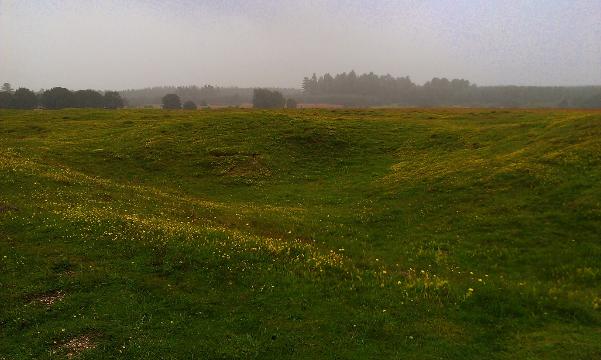
Grime’s Graves: landscape of Neolithic flint mining pits
Before It Built Walls, It Made Blades
Long before English flint entered architecture, it belonged to a much older story of when humans first discovered they could shape and transform certain elements of nature to fit their survival needs.
In prehistoric Britain, it was prized not for ornament but for edge. When struck well, flint breaks with extraordinary sharpness, which is why it became the material of axe heads, blades and tools in the Neolithic world. At places such as Grime’s Graves, people were already mining flint deep underground around 2650 BC, drawn to the same hardness and fracture that would later make it so distinctive in building.
What changed over time was not the material itself, but our relationship to it. The stone that once cut wood, hide and bone eventually began to shape walls, churches, gateways and whole townscapes across southern and eastern England.
Whereas in Roman hands it became structural and practical, in the medieval period its usage grew more composed, moving from rough rubble into coursed work, then into knapped surfaces and the graphic brilliance of flushwork. By the fifteenth century, flint was no longer simply useful; it had become expressive.
That long evolution is part of what makes English flint so compelling even now. It still carries something of its first life as a toolstone, something sharp and elemental; yet it also carries centuries of architectural intelligence.
Anyone wanting to see that deeper story in person can still follow it back to its origins. At Grime’s Graves, the prehistoric mine itself now includes interpretation and displays of Neolithic tools, while the Museum of Archaeology and Anthropology, Cambridge and the British Museum preserve flint hand axes, blades and other prehistoric objects that make the material’s first human life feel strikingly immediate.
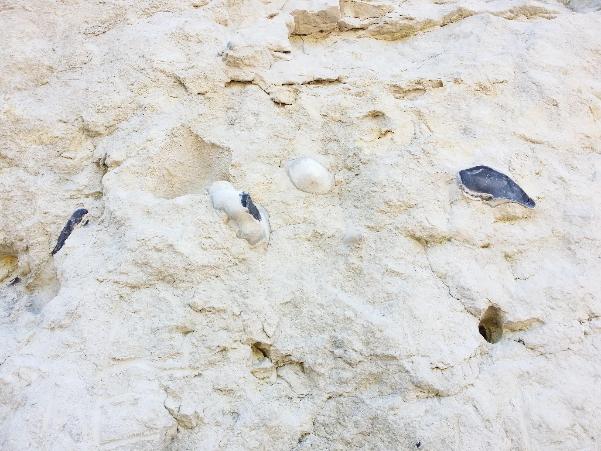
Flint nodules in the chalk cliffs at St Margaret’s Bay
How Flint Becomes Architecture
What makes flint so enduring in architecture is not just its appearance, but the way its physical properties shape the methods used to build with it. Flint is extremely hard and highly resistant to weather and decay, which is one reason so many historic flint structures have survived for centuries. Because the stone itself is relatively impervious, flint masonry is not quite like ordinary ashlar construction. It is a mortar-led system, one in which bedding, jointing and detailing matter just as much as the stone itself.
At its most vernacular, field flint or rubble flint is used in irregular pieces gathered from fields and local gravels, creating the quieter, more rustic character seen in boundary walls, barns and agricultural buildings.
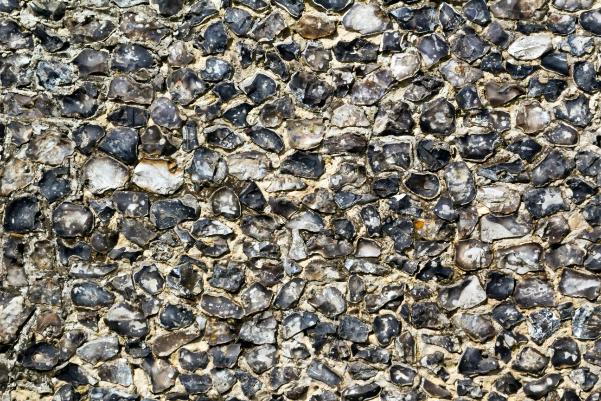
Rubble flint detail
At the other end of the spectrum comes knapping, in which flint is broken to expose its darker inner face and give the surface greater precision and visual intensity. Between those extremes sits a whole language of handling, sorting and dressing, each approach changing the way the material reads.
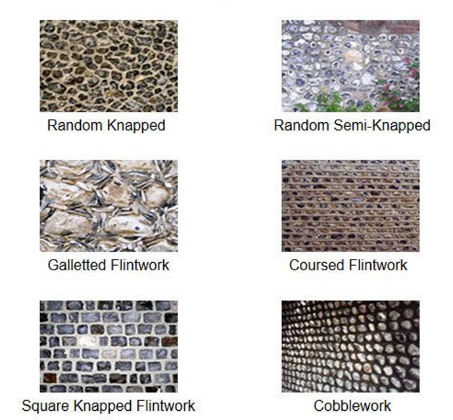
There are smaller techniques, too, that reveal how inventive builders became with flint. Galleting, for instance, involves pressing small flint shards into wet mortar joints, both enriching the texture of the surface and helping protect the joint itself. Of note to anyone choosing to work with English flint, is that even where it appears simple, flint almost always rewards close attention.
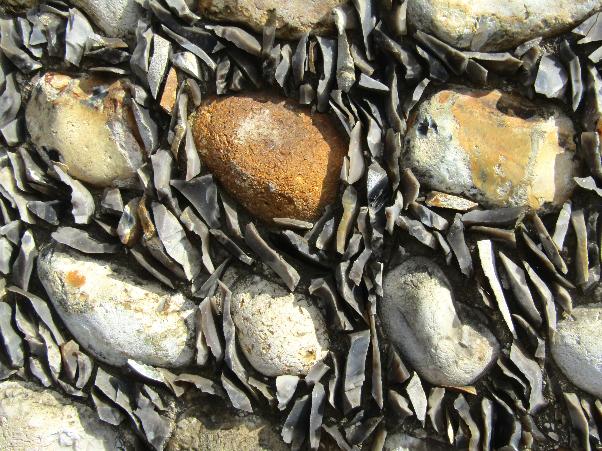
Flint galletting detail
This is also why the material demands respect from the outset; the more refined the result, the more important the craft. Flint has to be chosen not only for size but for tone, fracture and the quality of the exposed face. It must be laid with a clear understanding of how it will sit against mortar, openings, corners and adjacent materials. For architects, interior designers and contractors alike, that is part of its appeal, and its beauty comes from the way it is chosen, detailed and laid.
From Flint Walling to Flushwork
Historically, English flint became important for practical reasons before it became prized for visual ones. In regions such as East Anglia, good freestone was limited, while flint was abundant in chalk landscapes and local gravels.
That made flint walling the obvious answer for everything from boundary walls and farm buildings to churches, civic structures, gatehouses and fortified walls. Roman builders used it in rubble cores and in conjunction with tile banding. Medieval builders turned it into the quiet grey fabric of towns, villages and ecclesiastical buildings.
What changed the story was craft. Once builders began splitting and dressing flint to expose flatter, darker, more controlled faces, knapped flint emerged as something altogether more deliberate. Against pale stone dressings, knapped flint can look almost ink-black, which is one reason it became so powerful in façade work.
From there we arrive at flushwork, one of the great inventions of late medieval English architecture. Flushwork is a decorative masonry technique in which knapped flint and dressed stone are set on the same flat plane, so the wall begins to read less like rough construction and more like pattern, drawing and ornament.
Flint nodules are selected and quartered into workable pieces, then more finely flaked to create flatter, darker faces. These are bedded carefully into mortar beside pale stone, allowing masons to compose chequers, bands, shields, panels and tracery with remarkable precision. This is where flint moves beyond simple walling and becomes a form of architectural expression.
Some of the most memorable examples still feel almost graphic in their confidence. At Butley Priory Gatehouse in Suffolk, the façade is effectively drawn in stone over knapped flint.
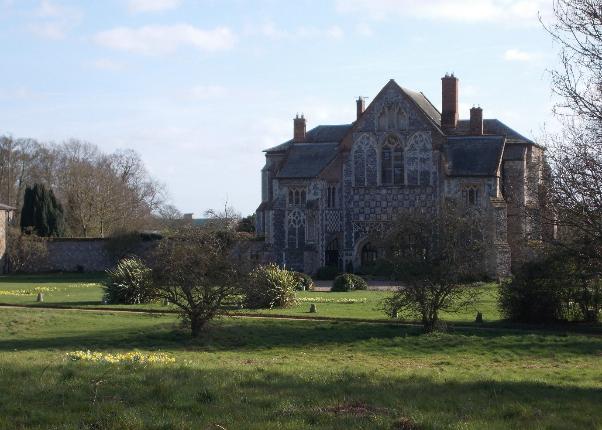
Butley Priory Gatehouse: East Anglian flint façade
St Ethelbert’s Gate in Norwich uses circular and patterned flushwork to make the threshold to the cathedral close feel both defensive and decorative.
In King’s Lynn, St George’s Guildhall belongs to that same East Anglian appetite for black-and-pale patterned surfaces, while churches such as St Margaret, Cley-next-the-Sea and Holy Trinity, Long Melford show flushwork at its most intricate and ambitious, spread across parapets, panels, inscriptions and whole elevations.
True domestic examples are rarer, which is part of what makes them so intriguing. Flushwork was costly, skilled work and was more often reserved for churches, gates and civic buildings than for ordinary houses. Still, its language does appear in more private settings and echoes. Westhorpe Hall, for example, was associated with black-and-white chequer effects possibly imitating knapped flint and stone flushwork; Montpelier House in Swaffham carries the same disciplined contrast of dark flint against lighter trim, and even the garden wall beside Nonsuch Park House preserves a lower section of chequered flint-and-clunch flushwork.
Yet the story of English flint did not end with the Middle Ages. The Regency and Victorian periods revived an appetite for it, particularly in ornamental garden architecture, coastal settings and townhouses, with Brighton remaining one of the best-known centres of that later enthusiasm.
When Flint Became a Design Language Again
In recent years, several architects have helped return English flint to the centre of design conversation. At Flint House on the Waddesdon Manor estate in Buckinghamshire, designed by Skene Catling de la Peña for Lord Rothschild, the material is treated almost as geology made architectural, grading across the façade so the building feels born from the chalk landscape itself. Such was the resolution of the project that it won RIBA House of the Year 2015.
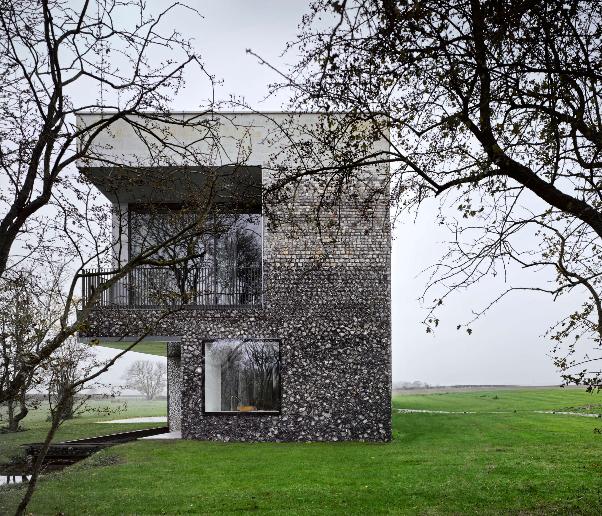
Flint House: contemporary flint architecture by Skene Catling de la Peña
In the sphere of interior design, David Mlinaric’s outstanding work there is a reminder that flint does not have to stop at the outer skin of a building. It can set the emotional tone for the rooms within, lending them gravity, texture and a sense of belonging to the landscape.
For interior designers, that is perhaps one of the most interesting lessons of all. Flint is not only a matter of external envelope or heritage reference; and used well, can give a space more depth, more character and a stronger material identity.
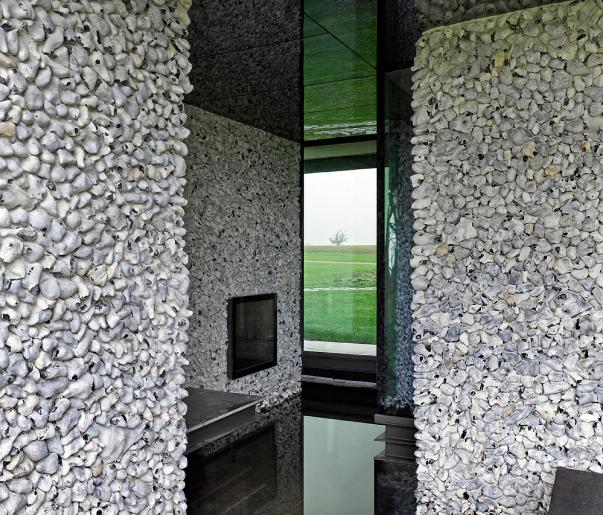
David Milnaric’s interiors at Flint House
At West Meadow, Hollaway Studio used a flint wall as both shelter and statement, allowing a contemporary house to sit more naturally within its Kent setting.
At Black Tile House, for example, HAPA Architects showed how flint can be reinterpreted with modern precision, including sharply resolved knapped corners and a carefully detailed cavity construction behind. These projects matter because they do not use flint nostalgically. They use it as a serious architectural language.
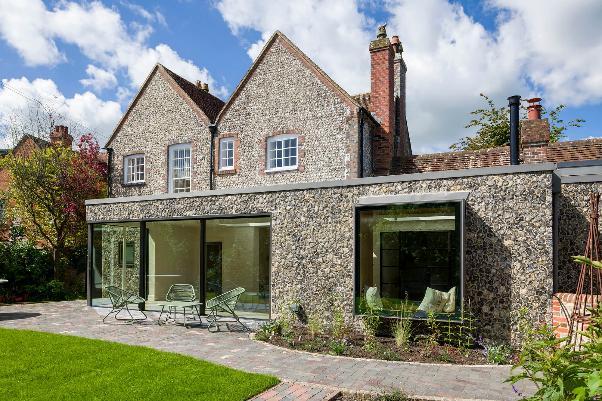
Black Tile House
There is also a quiet sustainability argument in its favour. Flint is minimally processed compared with many fired materials, and its long life becomes especially compelling when sourcing is local, detailing is intelligent, and lime-based systems allow for repair, reuse and selective dismantling over time.
It is not a material that lends itself to simplistic carbon claims, because transport, wall assemblies and mortar volumes all matter. Still, as a durable stone with an unusually long cultural life, English flint sits comfortably within the current return to materials that age rather than expire.
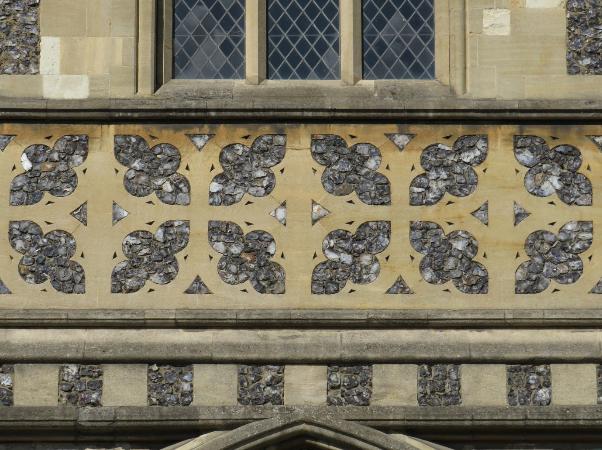
Flushwork at St Margaret’s Church, Cley-next-the-Sea
Building with Flint
To build well in flint is to accept from the outset that this is not a thin decorative finish but a real walling system, with its own logic of mass, backing, mortar and craft.
In traditional construction, masonry walls are made from units bonded together with mortar. With flint, however, the visible stone can account for surprisingly little of the finished wall once mortar, rubble infill and any associated brick or stone are taken into account. That is part of what makes flint so distinctive: it is as much a method of construction as a material finish.
Wall Thickness and Substance
Wall thickness has always depended on the size and purpose of the structure.
- In traditional cottage construction, a solid flint wall would usually be around 450 mm thick.
- More substantial buildings could be much thicker.
- Church towers, for example, may reach 1.5 metres.
- Even boundary walls were rarely especially thin.
That sense of substance matters, because flint has historically performed best when it is treated as something robust, not tokenistic.
Main Ways Flint Is Used
In practice, flint can be used in several different ways:
- as the foundation material for boundary walls and small outbuildings, in place of concrete
- as solid masonry, whether structurally or in non-structural applications such as freestanding walls
- with a rubble or blockwork core for boundary walling, as shown in fig. 1
- as the facing to a cavity wall, with brick, blockwork or another backing construction behind, as shown in fig. 2
- as a non-structural facing to another backing material, as shown in fig. 3
- in flooring and pathways
- more decoratively in combination with brick or stone for parapets, pinnacles or gate piers
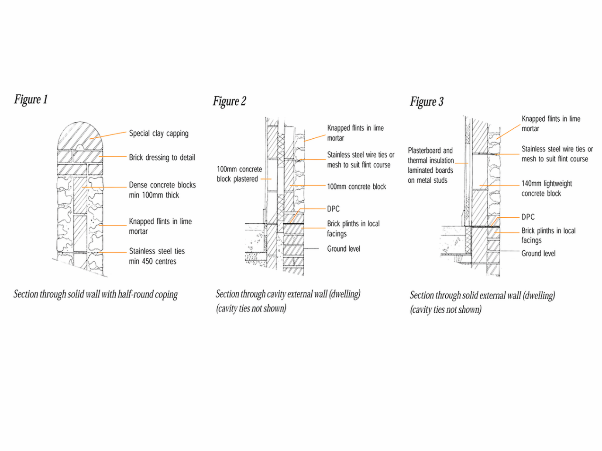
What matters is not simply whether flint is present, but whether it has been chosen in a way that suits the building type, performance requirements and architectural intent.
One contemporary response to the practical demands of building with flint is the cavity spacer rainscreen system sold under the name SureCav. Used behind a flint facing, it is designed to replace the traditional concrete backing block while maintaining a clear, dry and vented cavity.
The appeal is easy to understand: it offers a flatter backing for the flintwork, helps protect against wind-driven rain and mortar bridging, and can reduce overall wall width by around 125 mm, which in turn gives more room for insulation or internal floor area. Made from recycled plastic and marketed for use across all exposure zones, it is one of the clearer examples of how flint is being adapted to contemporary wall assemblies without losing its visual character.
Early Coordination Matters
Where flint is being considered for a contemporary project, building control, thermal performance and structural support all need to be thought through from the beginning. A solid 450 mm flint wall, for instance, is far from sufficient for a heated building by modern thermal standards without further intervention.
Flint Rarely Works Alone
In both facing and structural work, flint rarely acts alone. Piers, quoins, dressings and sometimes horizontal brick bands are commonly used to bind the flint face to the rest of the wall or to give corners and openings the precision that flint on its own struggles to achieve. Metal wall ties are also often introduced.
This combination of materials is not a compromise. It is part of the tradition of building well with flint.
Two Main Construction Methods
Freehand Flintwork
Freehand work is generally the more desirable method where a refined finish is the aim. It tends to produce a better result and is essential for coursed and rough-coursed work, where the flints are laid in horizontal rows and the spacing between pieces needs to remain visually consistent.
The central discipline is learning to bed the flints flat, as though the wall were being built against a sheet of glass, with a straight edge constantly checking that nothing projects awkwardly beyond the face. In freestanding work, string lines are used on both sides of the wall, while profiles help keep quoins and jambs true.
Shuttered Flintwork
Shuttered flintwork has a long history too, especially where rubble-cored construction or flint facings on a backing wall are involved. It can be effective in achieving flatter planes, though the finished effect is harder to judge while the work is in progress.
Before the shuttering goes up, any toothed quoins, piers, dressings, plinths or backing work should already be built to a minimum height roughly equivalent to the height of one board. The flints are then laid within the shuttering with their external face chosen first, rather like headers, with one end set firmly against the shutter and the other pointing into the body of the wall, slightly downwards and outwards so that water is encouraged away from the core rather than into it.
Good Flintwork Depends on Discipline
No two flints should touch. They should sit as close together as possible, but without crowding, so that mortar does its job without dominating the surface.
A few practical rules matter here:
- introduce long bonding flints at regular intervals
- pack voids carefully with brick or tile rubble
- take particular care around the toothing of piers
- use smaller flints to level each rise
- avoid thick bands of mortar, which distort the appearance and are more vulnerable to frost
One of the quiet disciplines of good flintwork lies here: knowing how to create a surface that feels natural and varied, but not sloppy; random in character, but not banded or crude.
Once a lift has firmed up, the shuttering is usually removed the following day and the process repeated. It is slow work, but that slowness is part of why good flintwork still carries such presence. It is not a material that rewards haste. It rewards judgement, sequencing and care.
English Flint in Practice: Common Problems and Better Solutions
For architects, designers and contractors, the decisive question is rarely whether English flint can be beautiful. It is whether it can be detailed well enough to remain beautiful. Flint is extraordinarily durable as a stone, but flintwork is vulnerable as a walling system. Its small, irregular, relatively impervious pieces rely heavily on mortar, bedding and careful detailing, which means many failures begin not in the flint itself, but in the way the wall has been assembled, repaired or asked to handle water.
The clearest way to think about it is this: English flint almost always rewards attention at the level of build-up, joints and maintenance. When that intelligence is present, the material can look rooted, precise and quietly exceptional. When it is missing, problems tend to appear in familiar places. Water gets in at weak junctions, hard mortar begins to crack, or the face loses bond with the core or backing. Repairs are carried out too heavily, and the wall loses both its performance and its character.
Water
One of the most common problems with flintwork is poor water management. Because flint absorbs very little moisture, rain tends to move through joints, interfaces and vulnerable details such as copings, openings, plinths and wall heads. When those points are weak, water works into the wall, washes out the mortar-rich core and gradually loosens the face. In flintwork, weather protection is not an afterthought. It is part of the architecture. Good copings, drips, robust junctions and a clear water-shedding strategy are doing far more than keeping a façade neat. They are helping the whole wall stay sound.
Mortar
A second recurring problem is the use of hard, cement-rich mortars. They are often introduced with the assumption that a durable stone requires an equally hard binder, when in practice the opposite is often true. Dense cement mortars can shrink, crack around the flints and trap moisture, encouraging damp, frost damage and long-term decay.
Lime-based mortars are generally the more compatible partner because they are more porous, more forgiving and better suited to a material whose success depends so heavily on the joints around it. In a flint wall, the mortar is not background material. It is part of the engineering of the surface.
Bonding and Build-Up
Poor bonding is another familiar weakness. Flint pieces do not interlock as neatly as regular blockwork, so embedment, joint depth and bedding are critical. If the face has not been properly tied back, or if the wall has been treated as a thin decorative skin rather than a properly resolved assembly, flints can dislodge, faces can detach from the core or backing, and cracks can begin to open around dressings and cappings.
This matters especially in contemporary work, where flint is often used as a facing to a more complex wall build-up. The answer is not to avoid modern construction, but to detail it honestly: decide the wall type early, specify how the flint face is tied back, keep cavities clear and drained, and build mock-ups so the jointing, mortar colour and visual rhythm can be tested before the main work begins.
How Paris Ceramics Can Help with Your English Flint Needs
At Paris Ceramics, English flint is no longer confined to the language of vernacular walling. For the first time, it is being reworked as a material for slabs, tiles and bespoke architectural pieces, allowing one of Britain’s most distinctive geological surfaces to move into a very different design register.
Selected English flint is sourced in Britain and sent overseas for specialist processing, where it is sorted, sliced and carefully set into resin to create finished slabs, tiles and mesh mounted interlocking mosaics. What makes the material so compelling is that it does not lose the visual identity of flint in the process. It retains its depth, variation and mineral drama, but gains the dimensional consistency and fabrication potential needed for contemporary interiors and architectural applications.
This opens the door to a remarkably broad range of uses. Paris Ceramics commissions have included whole bathrooms, worktops, vanity tops, upstands and splashbacks, table tops, reception desks, and both interior and exterior facades. In each case, the appeal lies in the same tension: the material still feels ancient, elemental and unmistakably British, yet it can now be handled with the precision of a modern surface.
The finish can be adjusted according to the character of the scheme. Flint may be honed for a quieter, softer presence, or polished to intensify colour, depth and reflectivity. In certain cases, it is also possible to expose the knapped face itself, preserving the richly irregular texture that gives flint its singular architectural charge. That option is especially powerful where a project wants to balance refinement with something more tactile and primal.
There is also a strong compositional advantage to the system. Bespoke pieces can be made for easy insertion alongside stone and other surfaces, allowing designers to use flint not only as a standalone statement, but as part of a broader material dialogue. It can sit against limestone, marble, ceramic or metal in a way that feels deliberate rather than decorative.
Horizontal Applications - Fabrication and Fixing
For horizontal uses such as worktops, vanity tops, tabletops and splashbacks, English flint panels are fabricated and installed in a manner closely aligned with marble and engineered stone slabs.
Each piece is templated, cut and finished off-site using standard stone fabrication methods. Installation typically involves:
- Placement onto a fully supported substrate such as cabinetry, steel frame or marine plywood base
- Fixing using high-performance flexible adhesives or epoxy systems
- Mechanical support where spans or loads require it, particularly for larger tabletops or cantilevered elements
- Jointing with colour-matched resin or epoxy, followed by careful finishing
- Perimeter sealing with silicone or compatible sealants to allow for movement and moisture protection
Because the material is resin-bound, it offers a degree of dimensional stability, but it should still be treated with the same discipline as natural stone in terms of support, span control and load distribution.
Vertical Applications - Walling and Cladding Systems
For vertical applications, the fixing strategy depends on scale, location and exposure.
Interior Wall Applications
For internal walls, bathrooms and joinery elements, panels can often be:
- Directly bonded to a prepared substrate using stone-grade adhesives
- Installed onto cement board, plasterboard (where suitable), or masonry backing
- Supported with temporary mechanical restraint during curing
This approach is particularly suited to:
- bathrooms
- feature walls
- reception backdrops
- furniture cladding
Exterior and Large-Format Applications
For exterior facades and larger-format panels, the approach shifts into the territory of engineered stone cladding systems.
Depending on panel size and project requirements, fixing may include mechanical restraint systems, such as:
- kerf-cut edge fixings
- undercut anchors
- stainless steel brackets or clips
- installation within a ventilated rainscreen system, allowing:
- drainage
- airflow
- thermal movement
- integration with aluminium rail substructures or similar support frameworks
In these scenarios, the flint panel behaves as a cladding element rather than a bonded finish, and detailing should follow the same principles used for natural stone facade systems.
A Material Between Traditions
What makes this development particularly compelling is that it sits between two architectural worlds.
On one hand, English flint carries deep associations with traditional construction - knapped facades, irregular coursing, and regional identity. On the other, this new format allows it to operate within the precise, controlled logic of contemporary slab materials.
At Paris Ceramics, this is where the real opportunity lies. Not in treating flint as novelty, but in allowing it to move fluidly between surface, structure and composition.
A material once defined by irregularity is now capable of alignment. A material once bound to masonry is now part of a broader architectural system.
And in that shift, English flint finds an entirely new relevance.
If you would like to discuss formats, finishes or how we can work with you, contact us for an initial conversation.
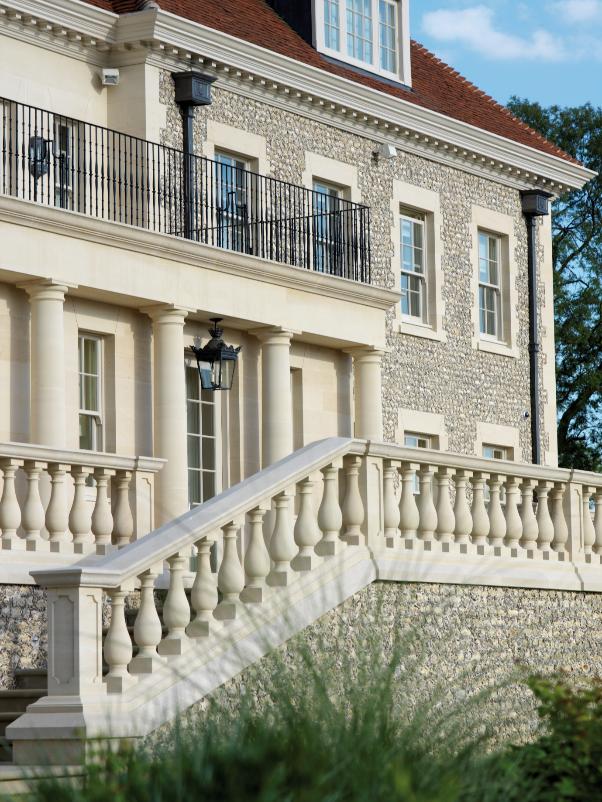
Little Halnaker, West Sussex: a Paris Ceramics project
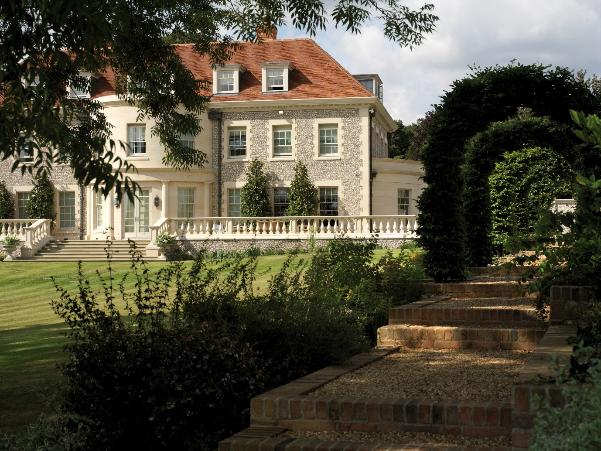
Little Halnaker, West Sussex: a Paris Ceramics project

Flint polishing process
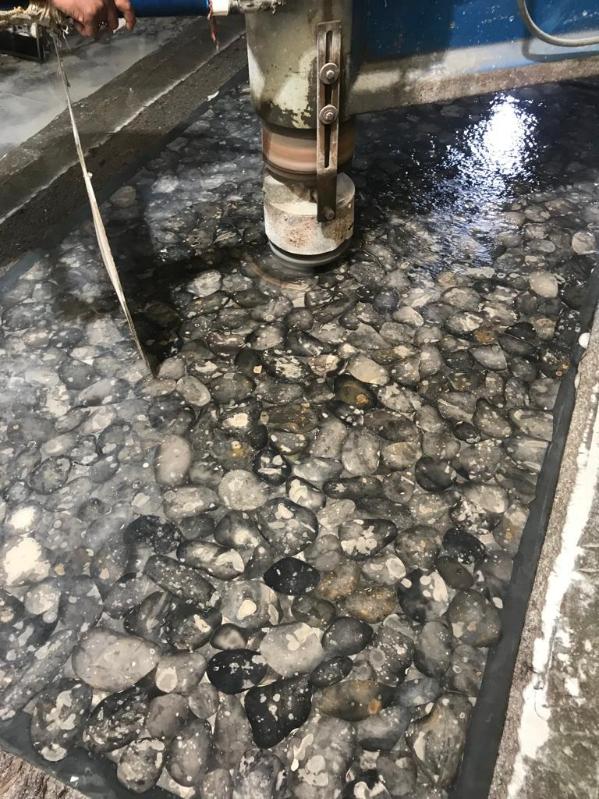
Close up of flint polishing process
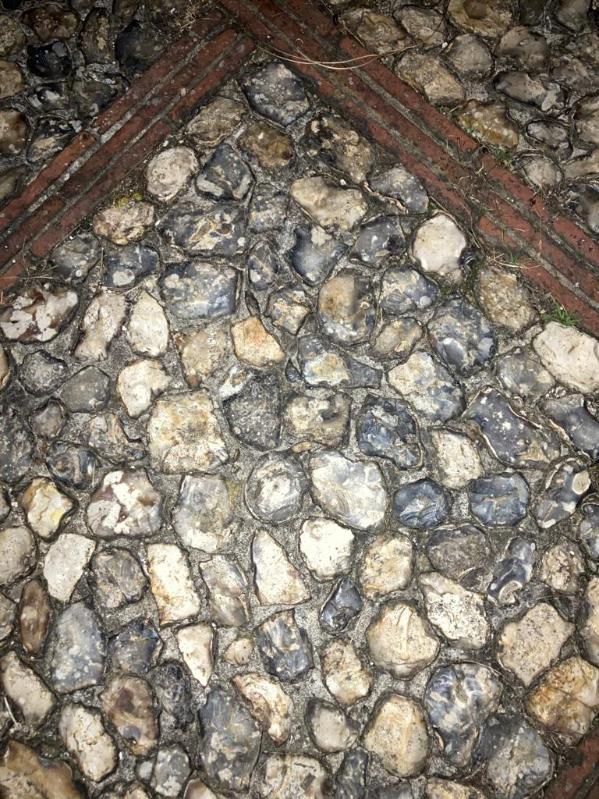
Original ancient flint floor
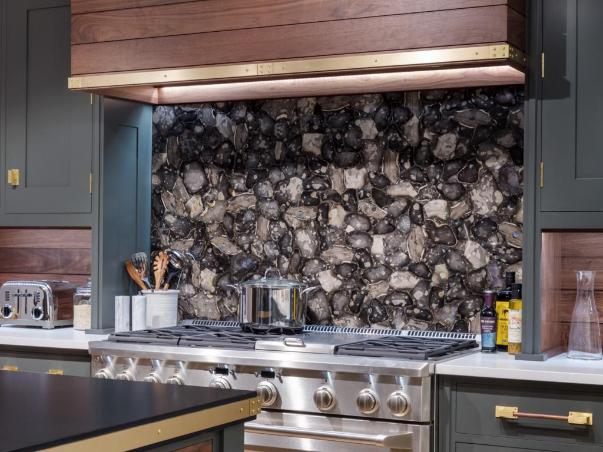
Kitchen backsplash for London residence
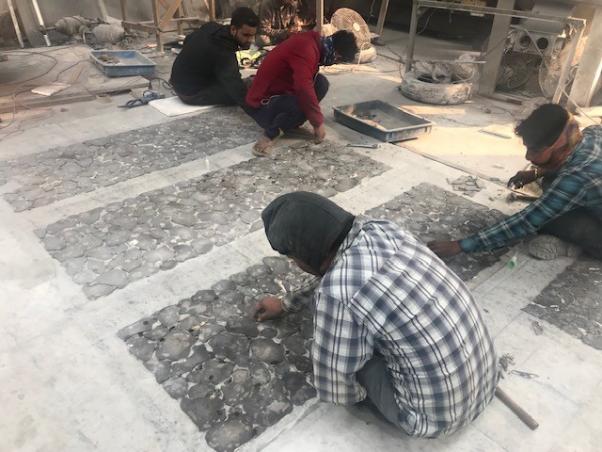
Flint Slab assembly
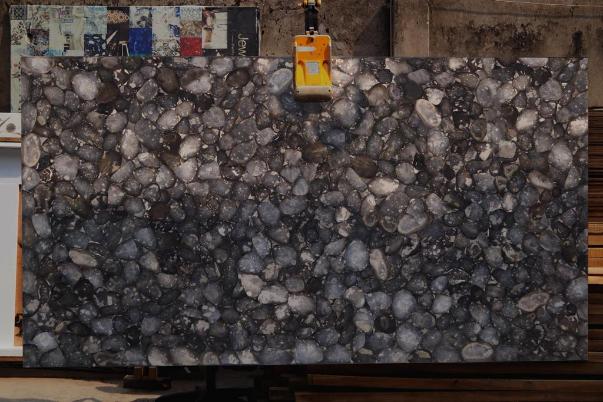
Polished flint slab
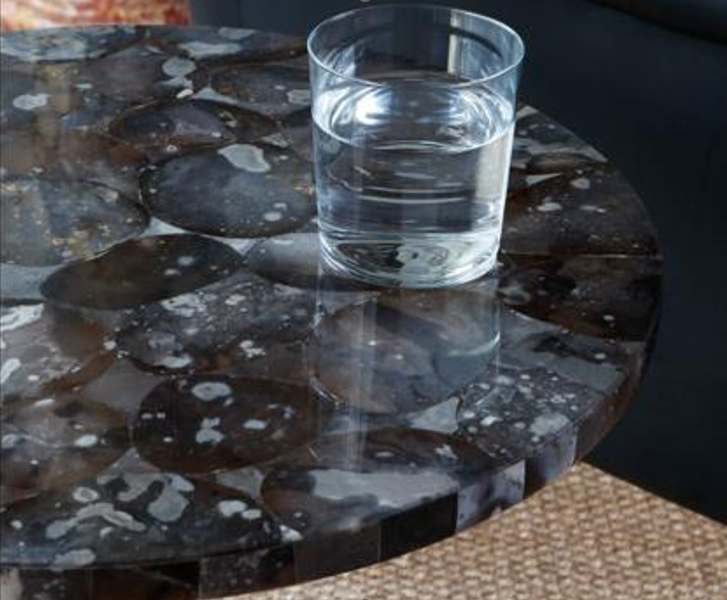
Customised Polished round table-top in flint
CPD Template for Architects
CPD Template for Architects
Logging This As CPD
If relevant to your role, current projects or wider professional development, this article may be recorded as unstructured CPD.
Suggested Core Topic
Heritage materials and conservation-informed specification
Suggested Learning Format: Self-directed reading
Estimated Time: 25-30 minutes
This article covered:
- The geological formation, historic use and architectural significance of English flint, from vernacular walling to medieval flushwork
- The importance of craft in shaping appearance and performance, including selection, knapping, dressing and orientation of the material
- Specification considerations such as moisture behaviour, mortar compatibility, lime-based systems, finish variation and the difference between expressive and more calibrated applications
Suggested CPD record summary:
This article expanded my understanding of English flint as both a historically embedded and currently relevant architectural material. It outlined how flint developed from a practical local building resource into a refined façade language, particularly through knapped flint and flushwork traditions. It also highlighted the importance of treating flint as a mortar-led system, with careful attention to detailing, water management and the suitability of lime-based mortars, especially where heritage character or material compatibility is important. The article also demonstrated how contemporary projects are using flint in a serious architectural way without reducing it to pastiche.
Suggested reflection:
I will apply this learning by considering how English flint might be specified with greater sensitivity to context, detailing, finish and material compatibility in future heritage-led or character-sensitive projects.
Please note
This content is intended for independent professional learning and should not be treated as accredited CPD unless expressly stated otherwise
CPD Template for Interior Designers
CPD Template for Interior Designers
Where relevant to your professional practice, this article may be useful to log as self-directed or unstructured CPD.
Suggested CPD record
Date completed: [DD/MM/YYYY]
Activity title: English Flint: The Dark, Glassy Stone with a Very English Memory
Provider / publisher: Paris Ceramics
Format: Online article / self-directed reading
CPD category: Unstructured CPD
Time spent: 25-30 minutes
Link: [Insert article URL]
What did you learn?
This article explained how English flint is formed, why it has such a distinctive dark, glassy appearance, and how its visual character changes through extraction, weathering and finishing. It explored the material’s long architectural history, from regional walling traditions to medieval flushwork, and showed how that heritage continues to inform contemporary design use. It also clarified the difference between hand-knapped, more faceted expressions and quieter, more controlled finishes.
Why is this relevant to your practice?
For interior designers, this is useful material knowledge because it supports better judgement around tone, texture, finish and setting. The article helps translate flint from a purely atmospheric idea into a material that must be understood in terms of craft, visual variation, application and detailing. It also supports more informed conversations with clients and project teams about where flint may be most suitable, such as feature walls, fireplaces or carefully resolved exterior transitions, and what kind of finished effect is actually being specified.
Actions / follow-up
Review whether any current or future schemes could benefit from a material with stronger textural depth and architectural memory. Compare hand-knapped and more precision-dressed finishes against the intended character of the space. Discuss maintenance, detailing and installation coordination early where flint is being considered. Record any client-facing guidance needed around natural variation, finish selection and overall visual expectation.
Please note
This content is intended for independent professional learning and should not be treated as accredited CPD unless expressly stated otherwise